
 Blog
Blog Every network error comes with a price tag. Some are the little things you might expect—a routine change gone wrong, or a downstream effect of network automation—while others are large enough to change the trajectory of your entire organization.
Across industries, we’re spending more on technology than ever before, averaging over $5 trillion globally in 2025.
But when I’ve talked with CIOs, CTOs, and CFOs, I always hear the same thing:
“We’re spending more than ever every single year, and yet I still don’t have a clear understanding of what we really have running in production, or where the risks are.”
When your network data is incomplete, inaccurate, or out of date, it can seep into your cost models, automation strategies, compliance posture, and more.
This problem is far larger and more expensive than most organizations realize—but also easily fixed. Read on to learn how you can:
- Improve network data quality.
- Drive more efficient spending.
- Build network resilience.
- Improve your compliance posture.
… All starting with your CMDB.
How Does Your CMDB Impact Network Costs?
At IP Fabric, we’ve been working with a customer in the energy sector—let’s call them ABC Energy—that has gone through several mergers and acquisitions (M&As) over the years. This left their network with a patchwork of inherited designs, duplicate tooling, and inconsistent documentation. The organization also experienced employee turnover, leading to a loss of institutional knowledge.
Through all of these transitions, ABC Energy expected that they had some CMDB drift, but didn’t know the extent of it. Let’s walk through all the ways this CMDB drift could impact their organization’s expenses.
Bad CMDB Data Can Drive Up Operational Expenses (OpEx)
Based on ABC Energy’s suspicions, we ran a comparison between their ServiceNow CMDB and a snapshot of their sample production network. Their CMDB listed over 420 devices, but their production network only had 380 devices. In other words, over 40 devices were “phantom devices” that were no longer in production.
When your CMDB is off by 40 devices, that’s not a rounding error. By extrapolating that 10% error out to their full estate of 1,100 devices, we could estimate that this CMDB accuracy problem was costing ABC Energy anywhere from $50,000 to $300,000 a year in unnecessary maintenance and renewal fees. And that was only the beginning.
Using IP Fabric’s end-to-end snapshot capabilities, ABC Energy also found over 100 incorrect hostnames and 90 incorrect serial numbers. On top of that, nearly every Cisco model name was wrong. If this foundational data is inaccurate, it can lead to issues with support eligibility, lifecycle management, CVE workflows, compliance policy adherence, and more—all the places you really don’t want to be wrong.
Bad CMDB Data Can Drive Up Capital Expenditures (CapEx)
Before onboarding with IP Fabric, ABC Energy’s network was wildly overbuilt. Every time they took on a new project or site, they did what most teams do under pressure: copy the latest design for every pod, gear count, port count, and redundancy. For a while, it worked. But it also meant that the network was growing in a way that had nothing to do with actual traffic patterns, device utilization, or business requirements.
When IP Fabric ran a snapshot of one of their regional networks, we found dozens of devices with utilization under 10%, as well as redundant devices that weren’t delivering anything meaningful. In one campus alone, they had four access switches per wiring closet, but their actual load only required two. If we zoomed out to an entire region, we found about 100 switches that ABC Energy was paying to maintain, but that weren’t fully utilized.
For context, these switches cost $4-6,000 apiece. On top of that, support contracts usually cost 10-20% of the hardware value each year, running around $500 per device.
IP Fabric discovered that about half of these devices were redundant, which means ABC Energy could save $250,000 during their next network refresh, as well as an additional $25,000 per year in maintenance fees.
All this time, network teams were making decisions based on the information they had. The information just wasn’t accurate enough to reveal the waste.
Bad CMDB Data Can Weaken Network Resilience
Let’s now consider the opposite scenario: Instead of overprovisioning their devices, what if ABC Energy had been running a sparing strategy?
This sort of strategy involves keeping a small pool of spare switches and routers on the shelf. If a device fails, the network team would instantly swap it from the spare pool instead of paying downtime costs while waiting for an RMA. IT leaders might think they’re saving hundreds of thousands of dollars a year by running lean—but if their inventory data is inaccurate, it could undermine even the smartest of strategies.
IP Fabric ran a discovery for another company that was adopting this sort of strategy, and found that out of their presumed eight spare devices, only two were actually there. Over the past few years, different teams had quietly pulled devices off the shelves and put them into production during incidents, urgent fixes, or site cutovers. All the while, none of these changes had been updated in their CMDB. As a result, this company was running a right-sized production network with absolutely no safety net.
That’s the real message here: you can have the right architecture, the right processes, and even the right financial model. But if your network data is wrong, the strategy collapses. You’re not just at risk of outages, but also the risk of undermining your own resilience.
Bad CMDB Data Can Cause More Downtime
Imagine the worst should happen, and ABC Energy’s network goes down.
If engineers have to cobble together a patchwork view of the network through multiple observability tools, they may have a hard time with root cause analysis—delaying Mean Time To Resolution (MTTR). But in global enterprises, every second counts, and unplanned downtime can cost anywhere from $39,000 to $2 million per hour.
Let’s say ABC Energy has an average of 24 hours of downtime per year, which is actually quite low. Even a conservative estimate puts them at $24 million in losses due to downtime each year.
When ABC Energy started using IP Fabric’s network digital twin platform to map out end-to-end paths, dependencies, and configuration states, they were able to see exactly what changed in their network, and how it impacted surrounding devices. This level of network visibility was the key to reducing MTTR from several hours to just 30 minutes.
Long story short: If your network data is wrong, your MTTR will be unnecessarily high. Once your team can see the actual state of your network—including the paths, dependencies, and changes—your outages will shrink dramatically, and your expenses with it.
Bad CMDB Data Can Lead to Noncompliance
CMDBs don’t just factor into device management; they also play a role in compliance. Take segmentation, for example. ABC Energy uses different levels of security to determine network segmentation, with strict rules about which levels can communicate.
Using IP Fabric’s end-to-end path lookup feature, they found several places where their actual network behavior didn’t match up with their segmentation policies. This may seem like a rarity, but when I ask organizations how they check their segmentation policies, most admit that they only do quick spot checks.
To understand why network visibility matters here, we can just look at news headlines. Duke Energy was fined $10 million for NERC SIP violations tied to their cybersecurity posture. The Colonial Pipeline ransomware attack cost roughly $20 million, between the ransom itself and the operational disruption that followed. More broadly, in the energy sector, data recovery and rebuilding can cost as much as $50 million per incident.
These stories aren’t just limited to the energy sector; they apply to other industries as well. Whether we’re talking about regulatory frameworks like PCI or HIPAA, or security frameworks like ISO 27001 or NIST, all require evidence of segmentation. And without a reliable view of the network, that evidence can be difficult to produce.
Luckily, ABC Energy wasn’t breached, but they weren’t sure about the extent of the security and compliance risks they were facing. The irony is that they didn’t need to buy a new SIM or spend millions on new firewalls. They just needed accurate data on what they actually owned, how their network was connected, and how their traffic actually flowed.
What Happens When You Can Actually Trust Your Network Data?
When customers use IP Fabric to clean up their network data, the value shows up in four key ways:
- Cost savings: See a direct, measurable reduction in spend, such as by eliminating unnecessary maintenance and renewal fees, removing redundant hardware, and rightsizing capacity.
- Cost avoidance: Prevent unnecessary spend before it happens, such as by rightsizing your network.
- Risk reduction: Reduce the likelihood of outages, failed changes, and misconfigurations that could lead to security or compliance issues.
- Revenue protection: Reduce downtime and develop more predictable workflows.
When you can trust your network data, all four of these levers start working at once, helping you to spend less on what you need while avoiding unnecessary cost and risk.
How To Improve Network Data Quality, Starting with Your CMDB
Accurate data is the key to keeping your business running at full capacity, whether you’re manufacturing products, making financial transactions, or delivering health care.
What does it look like when an organization gets it right? It’s simpler than you think.
Step 1: Maintain a Continuously Updated Model of Your Network
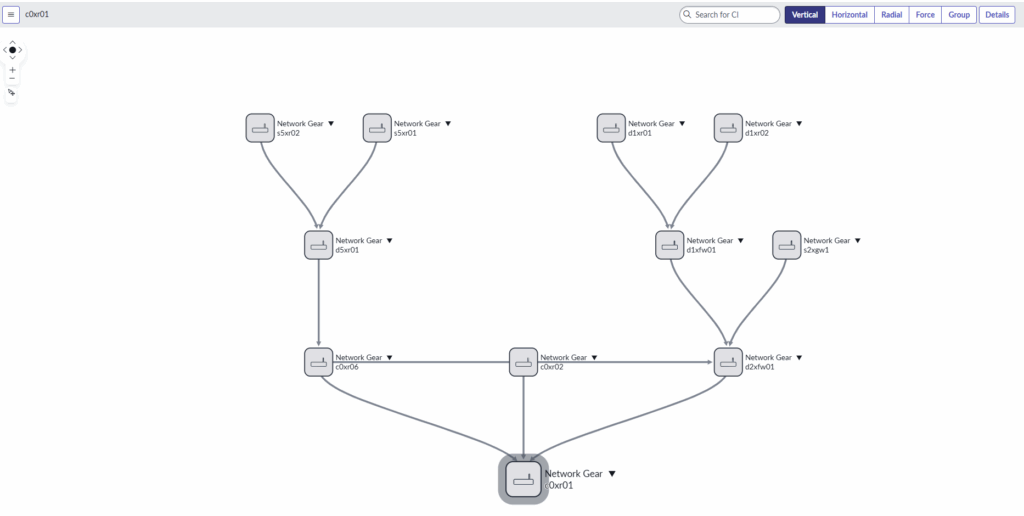
At the enterprise scale, it’s not enough to manually update a Visio diagram. Instead, network digital twins like IP Fabric create a living, interactive model that reflects every device, connection, and configuration from data center to campus to cloud.
Step 2: Use Network Snapshots to Understand Changes in Behavior
If you’re troubleshooting a breach or outage, you need to answer two questions:
- What changed, and how did it cause this issue?
- What was my network’s last known good state, and how can I get back to it?
For most teams, it can take hours or even days of investigation. But with IP Fabric’s network digital twin, you can remove the guesswork by comparing historical snapshots with your current view of the network.
Step 3: Continuously Validate Security & Compliance Controls
Network digital twins like IP Fabric can confirm that the network is behaving the way it was designed to. IP Fabric runs 160+ built-in configuration checks to ensure that segmentation boundaries are enforced, CVEs are mapped to the right hardware models, and that End-of-Life (EoL) devices are flagged before renewal cycles.
These checks are run against your actual network, so you can be sure that your CMDB always reflects reality, rather than a set of assumptions that were true six months ago.

Ready to Improve Your Network Data?
If you’ve read this far, odds are you aren’t completely confident in your network data. These four questions will help you to determine where your exposure is:
- What percentage of your network inventory has been checked against reality in the last 30 days?
- How many devices are you paying to maintain, that you’re no longer using or protecting?
- How much of your MTTR is spent finding the data, rather than fixing the issue?
- If an auditor walked in tomorrow, could you prove that your network data is accurate?
The truth is that “the hidden bill of bad data” is always being paid. You pay it in unnecessary renewals. You pay it in risk exposure. You pay it in delayed projects.
I’ll leave you with this: Fixing your network data isn’t just an engineering project. It’s one of the most powerful ways to reduce cost and risk, all while moving faster than everyone else.
Contact the IP Fabric team today to learn how we can help you regain confidence in your CMDB and network data.
FAQs
How Common Is It To Have Inaccurate Network Data?
Almost every enterprise deals with it. When customers take their first snapshot with IP Fabric, we discover inaccuracies 100% of the time. In many cases, as much as 20–40% of CMDB data is inaccurate, which creates downstream issues for budget planning, compliance audits, and digital transformation projects.
Why Is Bad Network Data Such a Pervasive Problem?
Networks are always changing, and it’s virtually impossible to keep up with those changes manually. Maybe a device was removed from production, but your CMDB wasn’t updated. Maybe someone input a hostname or a serial number incorrectly. Usually the reason behind these errors is structural, especially if your organization is undergoing digital transformation like M&As.
Why Should I Care About My Network Data Quality?
Your CMDB is more than just a static device inventory; it plays into everything from automation to lifecycle planning to compliance reporting.
If you can trust your network data, that can give you a leg up with:
- Building trustworthy AI and automation.
- Accelerating compliance audits.
- Keeping digital transformation projects on track.
- Accelerating troubleshooting, and reducing MTTR.
- Reducing CapEx and OpEx.
Is IP Fabric a CMDB Discovery Tool?
In a way, yes. IP Fabric discovers your network by leveraging read-only credentials and CLI / API commands to map every device, connection, and configuration from core to cloud to edge. After discovery is complete, IP Fabric builds a digital twin of the network, which customers can use to:
- Fuel agentic AI or automated workflows.
- Validate security and compliance controls, like segmentation.
- Run end-to-end path lookups to anticipate the effect of changes before they’re made.
- Accelerate troubleshooting by comparing with past snapshots.
Can IP Fabric Run a CMDB Audit?
Yes, IP Fabric can be used to audit your CMDB. Every time IP Fabric runs a discovery, it also runs a series of checks to ensure that your network behavior is aligned with your business intent. IP Fabric offers 160+ pre-built checks based on leading security and regulatory standards, but also makes it easy to create custom checks without any advanced knowledge of coding or query languages. The results of all checks are presented in normalized, vendor-neutral dashboards that can be easily exported to executives and auditors alike.
Can IP Fabric Integrate with My ServiceNow CMDB?
Yes. IP Fabric’s ServiceNow CMDB extension can sync directly with your ServiceNow instance to surface any inconsistencies, such as:
- Devices that are in IP Fabric but not in ServiceNow.
- Devices that are in ServiceNow but not in IP Fabric.
- Devices with different attributes between ServiceNow and IP Fabric (e.g. host names, serial numbers, model numbers).
From there, IP Fabric can automatically update your ServiceNow CMDB Network Gear Table using data from your latest network snapshot.
Contact our team to see this extension in action, or watch the full webinar on demand.