
 Blog
Blog Ask any IT leader, and they’ll tell you the same thing: network costs are outpacing budget growth.
In order to take on more ambitious digital transformation projects—like SD-WAN or AIOps—leaders must find ways to reduce capital expenditures (CapEx) and operational expenses (OpEx), all without compromising SLAs.
But herein lies the problem; if you can’t see what’s in your network, how can you even begin to optimize it?
This is where a network digital twin comes into play. After discovering all the devices and dependencies on your network, IP Fabric’s digital twin simulates the connections and configurations that tie them together, forming a dynamic snapshot of your network’s behavior at a given point in time. Equipped with this stateful and normalized view of the network, you have all the data you need to reduce IT spend, optimize project planning, and automate key security and compliance workflows.
Let’s walk through a few of the most impactful ways you can reduce CapEx and OpEx with IP Fabric.
Learn more about the benefits of a network digital twin.
Stop paying unnecessary hardware, software, and maintenance fees
When new customers run their first snapshots with IP Fabric, we find CMDB inaccuracies 100% of the time. CMDBs misrepresent as much as 20-40% of what’s in the network, and they do so in three key ways:
- Devices are documented in your CMDB, but aren’t running in your network.
- Devices are running in your network, but aren’t documented in your CMDB.
- Devices are documented in both your network and your CMDB, but with different attributes (e.g. incorrect model names or serial numbers).
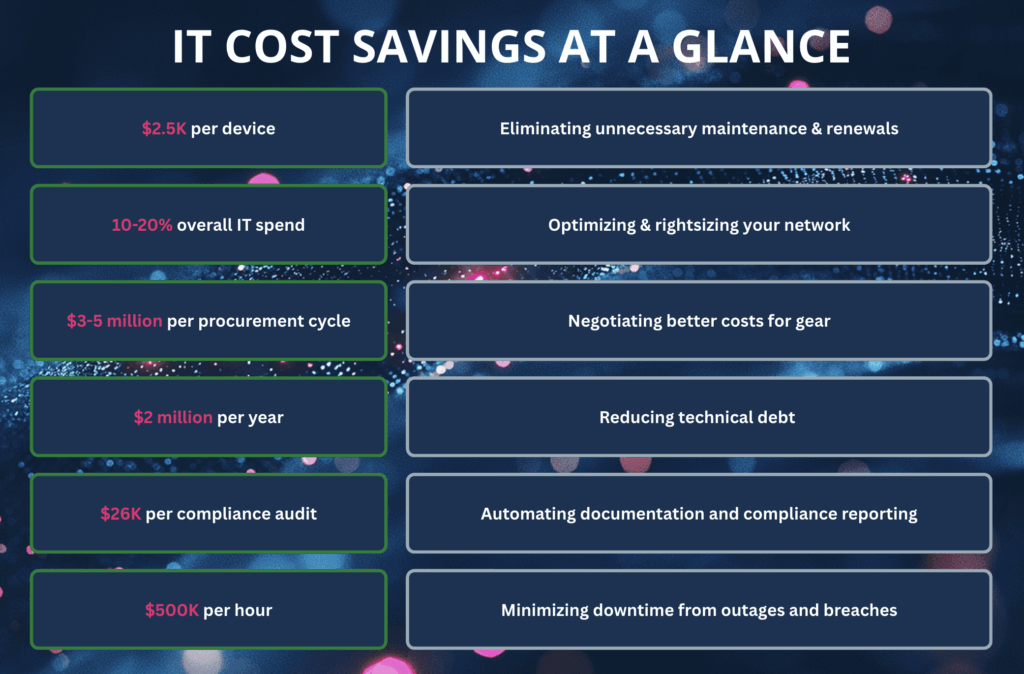
One IP Fabric customer found that out of the 5,000 devices in their CMDB, 850 were no longer in production. If each of these devices cost an average of $2,500 per year to maintain, then this customer could have been overcharged by $2.125 million for their annual renewal.
That same customer also discovered more than 300 devices that were in production, yet not included in their CMDB. These devices were unmanaged, and posed a risk to network security and regulatory compliance—but we’ll talk more about that later.
Learn how to improve CMDB accuracy.
Rightsize your network
Every network accumulates inefficiencies over time. Migrations and uneven growth often leaves some areas overbuilt, while others fall behind. The result: you’re paying to power, license, and maintain equipment that no longer adds value.
IP Fabric’s network digital twin gives you a complete picture of how your network actually runs. It shows where capacity is sitting idle, where traffic is pushing limits, and where small changes could have the most impact. With that visibility, you can consolidate hardware, balance workloads, and optimize performance without sacrificing redundancy or control.
In their report on “Best Practices to Optimize Network Spending,” Gartner estimates that this sort of “increased utilization” could reduce network costs by roughly 10-20%. For an organization with, say, $5 million in annual IT costs, that might translate to $500,000 in savings up front, and $255,000 per year after that.
Discover the business impact of network visibility.
Negotiate a better cost for network gear
You’ve rightsized your network, and ensured that your CMDB is continuously updated. With this visibility, you can see that a few of your devices are approaching End-of-Life (EoL), and are due to be replaced.
Perhaps you’re looking to replace devices from one vendor with devices from another. Or perhaps you’re looking to stay with the same vendor, but ask for a better price. Either way, IP Fabric’s network digital twin delivers a normalized view of all devices and vendors, which you can leverage in your negotiations.
Gartner estimates that this sort of competitive RFP can lower pricing by as much as 20-40%. To put that in perspective, a single enterprise router can cost anywhere from $15,000 to $25,000. If your organization manages 1,000 of such devices, a 20% discount could save you between $3-5 million per procurement cycle.
Learn how IP Fabric normalizes network insights.
Eliminate tech debt
Imagine you’re a network manager at a global wholesale company. After a series of mergers, you’ve seen steep growth—and with that growth comes a buildup of tech debt. That debt can quietly consume up to 40% of your IT budget each year, but you can’t address it until you know what’s actually running in your network. It takes roughly six months to document your network by hand, and by the time it’s done, your documentation has gone woefully out of date.
What you need is a current and reliable source of truth to guide modernization, and IP Fabric gives you exactly that. It models the network from end to end, mapping every dependency between devices, sites, and applications. It shows you which parts of the network still rely on outdated hardware or unsupported software, and how those systems tie into critical services. With this level of insight, teams can modernize with precision and save up to $2 million a year once legacy systems are retired.
Learn how a network digital twin can reduce tech debt.
Automate compliance workflows
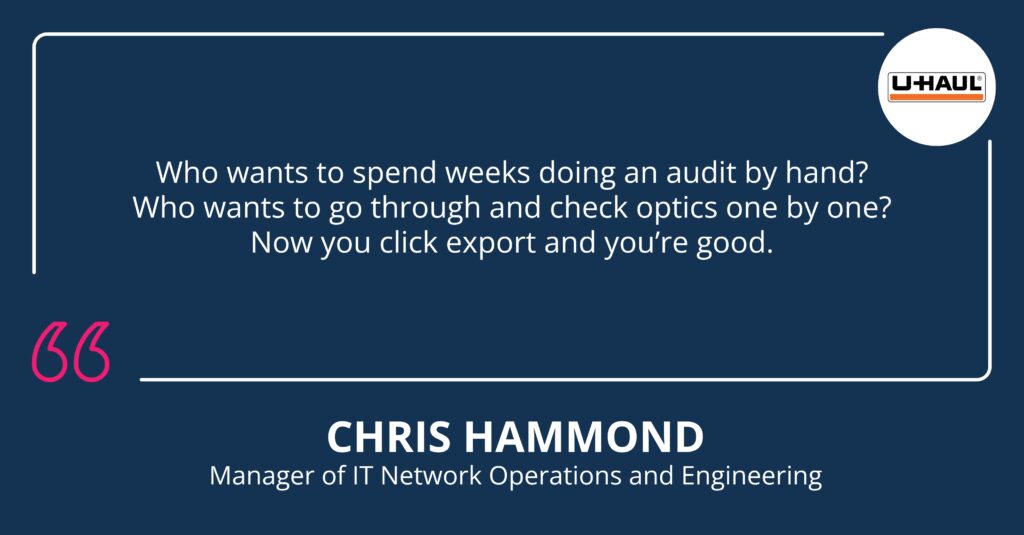
Every six months, U-Haul’s team was faced with a daunting task: Documenting dozens of switches, firewalls, and other devices to prove compliance with strict regulatory standards like PCI DSS and HIPAA. Each audit cycle could take a month or more, and consumed valuable time that could have been spent on more strategic projects.
With IP Fabric’s digital twin capabilities, U-Haul mapped their entire network from core to edge to cloud in just a few minutes. Now, U-Haul runs network-wide snapshots several times a day. In each snapshot, IP Fabric gathers a complete inventory of devices, and runs a series of security and compliance checks to ensure that U-Haul’s infrastructure is behaving according to business intent. The results of all checks are presented in a standardized, timestamped format, so they can be evaluated at a glance; network managers can check for compliance over their morning coffee, and network engineers can export audit-ready reports to auditors on demand.
Another IP Fabric customer, Air Bank, saw similar results after compressing their audit prep from 30 days to just 30 minutes. Let’s use this as the baseline for our next example: If a team of three network engineers spends a full month on audit prep, and each engineer is paid about $55 per hour, then that compliance audit costs roughly $26,000 in labor. If audit prep was automated, it might only take one engineer 30 minutes—or $27—to complete.
Read the full U-Haul case study.
Avoid preventable risks
No matter how much of a “green field” you network is, devices will inevitably age out of support, configurations will drift, and changes will ripple through your environment in ways that aren’t always easy to predict.
IP Fabric’s network digital twin gives you the visibility and control to catch those shifts before they impact your network security or stability. Each snapshot verifies that security controls like next-gen firewalls, transparent firewalls, IPSec tunnels, and segmentation policies are behaving in line with business intent. By regularly validating and documenting these controls, you can identify and remediate any gaps before they can introduce risk. On top of that, you’re also automatically generating proof of compliance with security frameworks like NIST and ISO 27001.
If the worst should happen, IP Fabric stores a historical snapshot “last known good state” to guide remediation. IT and security teams can see exactly how the network behaved before the issue began, so they can restore it in a fraction of the time—minimizing the cost of downtime and breaches.
Watch our expert roundtable on “Network Assurance in the Age of Compliance and Cybercrime.”
Reinvest your saved network costs in high-impact projects
IT costs will always outpace budgets. A network digital twin can help to close the gap by delivering the visibility and control to cut costs, even while taking on high-impact digital transformation initiatives.
Want to see the impact IP Fabric’s network digital twin could have on your network? Talk to an expert to set up a personalized demo.
FAQs
How is a network digital twin different from an observability tool?
Network monitoring tools can tell you when something breaks; network digital twins help you stop it from breaking in the first place. Your monitoring tools will alert you the moment an outage hits production, but by then the damage is done. A network digital twin lets you test that firewall rule change or SD-WAN policy update in simulation before it goes live, so you can validate that your security controls work the way you expect them to before they have the chance to cause costly breaches or outages.
How quickly can a network digital twin deliver ROI?
Most organizations see returns immediately. You’ll spot unused and over-provisioned hardware in your first snapshot, which translates to instant savings on licensing and support contracts. From there, the benefits compound. Compliance audits happen twice a year, but IP Fabric keeps you audit-ready at all times. You’re not scrambling to document your network when the auditors show up, which means lower operational costs and no risk of fines or lost customer trust from a failed audit. The same visibility helps you prevent breaches and outages year-round by catching vulnerabilities and misconfigurations before they can impact your network.
How does a network digital twin de-risk SD-WAN rollouts and digital transformation?
Before you embark on any sort of digital transformation project, you need to have a complete and accurate understanding of your network’s behavior, including all of its connections and dependencies. IP Fabric provides a dynamic map of network behavior so that you can proactively:
- Plan your SD-WAN architecture.
- Detect misrouted or dropped traffic.
- Monitor BGP and routing health.
- Validate security and compliance controls (e.g. segmentation).
These capabilities help you to surface any issues before they’re pushed to production, so you can prevent costly rollbacks and eliminate unnecessary spend.
How does a network digital twin help with incident response?
When an outage hits, you need to find the cause—and fast. Your logs and device outputs show fragments of what happened, but not how traffic was supposed to flow. Without that complete picture, resolution can take days, and downtime costs add up.
The first step for effective troubleshooting? Comparing your actual network against its last known good state. IP Fabric’s network digital twin stores historical snapshots for exactly this purpose, and enables teams to run end-to-end path lookups to investigate where and why traffic stopped flowing. This visibility is crucial for accelerating troubleshooting and restoring services in a matter of hours, rather than days.
How does a network digital twin help with budget planning?
IP Fabric discovers, maps, and documents all network devices in every snapshot. This snapshot homes in on any discrepancies between your actual network and your CMDB, including idle devices and devices that have been removed from production. With this data at your fingertips, you’ll be able to rightsize your network and save on unnecessary renewals, freeing up hundreds of thousands of dollars in your budget.