
 Blog
Blog There’s a metric on IP Fabric’s website which says that we find unknown devices in 8 out of 10 of our proof-of-concept (POC) deployments. This network visibility is significant but still doesn’t come close to describing our usual findings. In this article, I’m going to attempt to convey the kinds of immediate business impact IP Fabric can have by describing a specific POC currently running as of the writing of this article. These are the numbers that the business cares about which will help them understand what you and your teams go through every day to not only keep the business running, but to avoid millions in costs and penalties, and even ensure faster go-to-market for revenue-generating services.

The company we are working with in this case is in the Energy sector, but these findings are applicable across most industries. We’ll call this company ABC for now. We estimate that ABC company will see the following Business Impact by using IP Fabric. Again, this is limited to the use cases discovered in the first few weeks of a partial deployment.
First Use Case: Inaccurate CMDB – Business Impact: $300,000 Cost Savings
Missing Devices
ABC knew they had some Configuration Management Database (CMDB) accuracy issues because they were using other ITAM and monitoring tools which were presenting conflicting information. CMDB accuracy is very important because CMDBs are used as the Single Source of Truth (SSOT) for inventory management, impact analysis, change management support, automation sources of truth, compliance readiness, and more.
In production, IP Fabric will cover your entire network with at least 1000 layer 1-4 devices. For our POC deployments, though, we generally only do a part of the network. We deployed IP Fabric at ABC and then the operations team ran a network audit – a CMDB analysis comparing what they had to what IP Fabric was showing. In this analysis it showed:
- The CMDB had 425 devices in inventory and IP Fabric discovered there were only 383 devices actually on the network.
In this case, the CMDB is showing devices that are no longer on the network. Which means when it comes time for renewals, ABC will be paying much more for licensing than they should be. If we assume the missing devices are all fairly inexpensive switches at $10,000 each, then support and renewal costs about $2400. This adds up to about $108,000 total. Remember that this is only a portion of the network, though. ABC actually has 1100 network devices, so if we assume about the same number of missing devices in the other parts of their network, we’ll just estimate by multiplying that full number by 3, which puts it at about $300,000 that ABC would be paying in renewals for devices they are no longer using. Keeping up with accurate network visibility not only leads to cost savings, but also simplicity of operations.
Cost savings Use Case 1 so far: $300,000
Incorrect Hostname and Serial Numbers
Next the team found that there were 102 hostnames and 96 serial numbers which were incorrect in the CMDB, as IP Fabric showed the correct hostnames and serial numbers. Again, inaccurate network visibility can wreak havoc on network managment. Incorrect serial numbers may lead to difficulty in the support and RMA process. While incorrect hostnames might seem like more of a benign problem, in many cases monitoring, security, and automation policies are based on hostnames. They often use regex (name/string matching) commands to automate policy applications based on hostnames. Your operations teams make bulk changes based on host names and devices with incorrect hostnames will be missed. It’s difficult to put a business impact number on something that could go wrong in so many ways, but here’s a compliance example:
North American Electric Reliability Corporation Critical Infrastructure Protection (NERC CIP) is a cybersecurity regulation to which many energy companies must adhere. The penalties for non-compliance can be up to $1M per day. We’ll use Duke Energy’s recent fine as our example here. Duke was fined $10 million for violations of NERC CIP standards, some of which posed a “serious risk” to grid reliability.
Cost savings Use Case 1 so far: $10,300,000
Incorrect Model Names
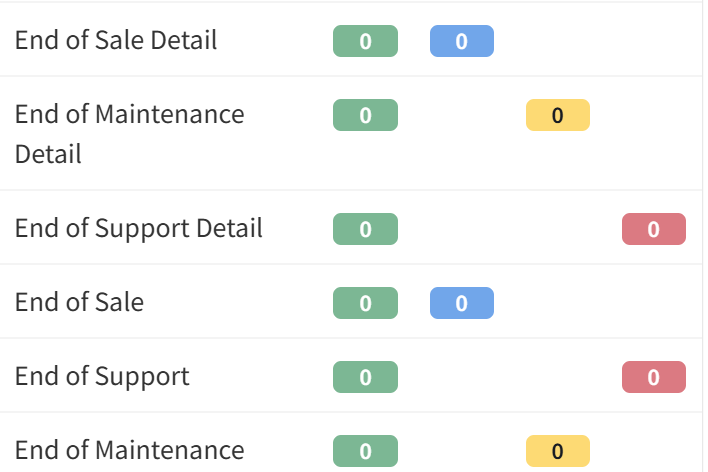
Using IP Fabric, the team then realized that nearly all the model names of the Cisco devices were not correct in the CMDB. This could cause internal confusion again when it comes time for the renewal. However, it can also cause issues if they’ve automated security patching based on the model name. When CVEs come out, they may miss certain devices if they do not have the correct model names in your inventory. Likewise, keeping track of EOL/EOS information in an automated way becomes impossible when we don’t know correct model names. This could all lead to a security breach.
We’ll use another recent example, the Colonial Pipeline ransomware attack, to estimate the cost of a security breach in the energy sector. Cost: Estimated $5 million ransom paid and $15 million+ in operational costs.
Cost savings Use Case 1 so far: $20,300,000
Second Use Case: Validating Segmentation – Business Impact: $50,000,000 Cost Savings
ABC company has several different security levels, each more restrictive than the last. They go from level 1 to level 6. For example, devices in level 1 should not be able to communicate with devices from other levels. Using IP Fabric’s end-to-end path lookup capability, ABC can ensure that the network is segmented properly. If they find that it’s not, it would be a huge vulnerability.
Let’s use a different real-world example from the energy sector which illustrates how costly a data breach could be. In 2012, Saudi Aramco estimated a $50+ Million cost in data recovery and infrastructure replacement after a malware attack.

Third Use Case: Rightsizing Your Networks – Business Impact: $500,000 one-time cost and $255,000/yr
About 15 years ago, I wrote a book on vCenter Operations Manager, which is when the idea of a “What-if Scenario” and “Rightsizing VMs” became popular in the IT world. Of course, this is all expected and easily done on the compute side, but network visibility into capacity isn’t always as easily done on the network side. ABC wants to do an analysis of unnecessary devices currently on their network because of a buildup of technical debt due to M&A activity. For example, they want to standardize their networks and may need to replace devices, but in many cases a 1-to-1 replacement won’t be necessary, even while retaining necessary redundancy. So instead of replacing all four switches at a site, they may just replace with two, as long as those two switches can handle the capacity. IP Fabric can help them understand their capacity needs on those switches. Let’s assume they find 100 redundant devices for this example.
Financial:
- Current Annual Cost of 100 Redundant Devices
- Support: 100 x $2000 = $200,000
- Licensing: 100 x $400 = $40,000
- Power: 100 x 150 = $15,000
- Total: $255,000/year
- Cost of Standardization:
- Assume 50 new devices are purchased to replace the 100 redundant ones at $10,000/device
- Total one-time cost: 50 X $10,000 = $500,000 instead of 100 X $10,000 = $1M
- Total savings: $500,000
Operational:
- Simplified management cue to accurate network visibility – standardizing, and reducing device count
- Lower risk of misconfiguration and improved MTTR
Compliance and Security
- Improved alignment with regulatory standards
- Reduced attack surface with fewer devices
The Broader Business Impact of IP Fabric’s Network Visibility and Control
The above examples highlight the transformative business impact of IP Fabric’s network visibility and control, but we’ve really only scratched the surface. Beyond optimizing your network, the platform also addresses critical use cases that directly enhance operational efficiency, compliance, and security.
Consider these areas where IP Fabric delivers even more value:
- Change Incident Management: Reducing the time to trace end-to-end packet flow from half a day to just two minutes with end-to-end path lookup. For example, resolving broadcast storms in minutes by leveraging a global MAC address list instead of hours of manual troubleshooting.
- Compliance Drift Detection: Spotting VLAN mismatches or identifying speed and duplex mismatches out of the box – critical insights that could prevent hours of downtime during a migration.
- Device Lifecycle Insights: Identifying devices with excessive uptime or misconfigured privileges which increase attack surfaces and operational risk.
For organizations like energy companies where networks are embedded in critical business activities, IP Fabric’s end-to-end network visibility ensures operational stability, security, and compliance, safeguarding not just the network but the business itself.
This is the kind of proactive insight and business impact IP Fabric has – helping you take control of your network before small issues become big problems. If you are interested to learn how we can help your teams better align with your business and ensure your executive teams know about your business impact, reach out!