
Enterprise
Network Automation

Emerging From the Dark Ages
& Reaching Toward NetDevOps
The forward-looking enterprise knows that to meet operational resilience and strategic transformation goals, be it in a year, three years, or five, they must get on board with network automation.

Read the Report
91%

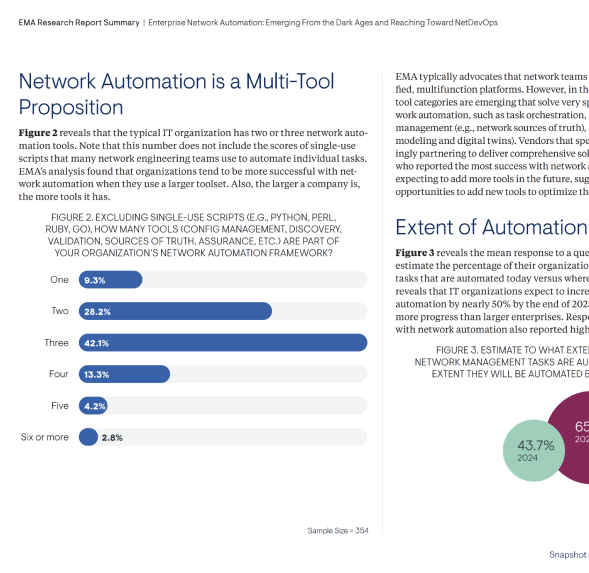
of companies interviewed use 2 or more tools as part of their network automation framework

Reduce Manual Processes
For Maximum Impact

Based on findings from Shamus McGillicuddy, VP of Research at Enterprise Management Associates, three factors are inhibiting the success of automation projects:
1
The inherent complexity and scale of modern enterprise networks 
2
The multi-tool nature of network automation  
3
The cultural habit of managing network equipment manually  

So, what are those
who cry “Success!”
doing differently?

This report, based on results from 354 IT professionals, and 10 network professionals interviewed one-on-one, delves into the key drivers for network automation, as well as the top technical and business issues blocking the success of automation projects.
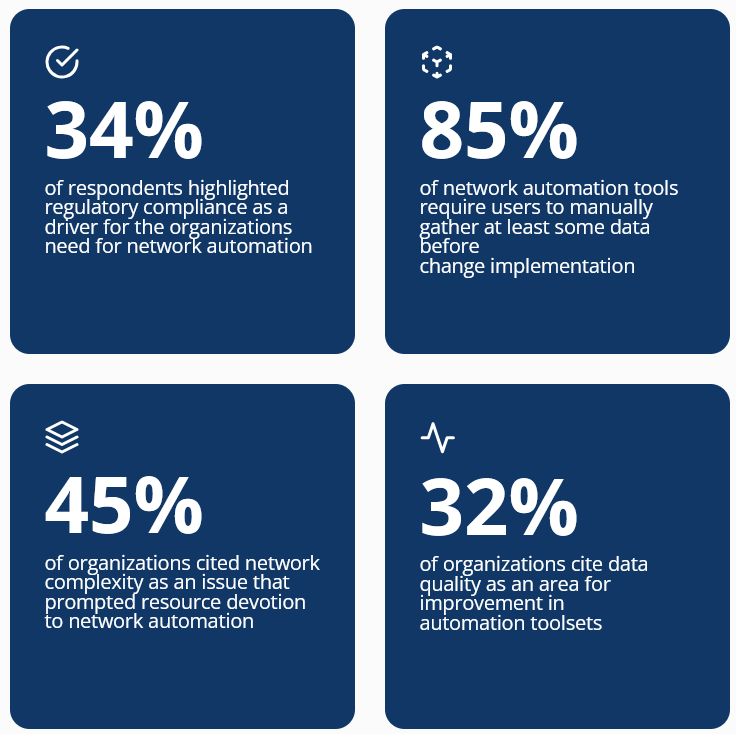
34%
of respondents highlighted regulatory compliance as a driver for the organizations need for network automation
85%
of network automation tools require users to manually gather at least some data before change implementation
45%
of organizations cited network
complexity as an issue that
prompted resource devotion to network automation
32%
of organizations cite data quality as an area for improvement in
automation toolsets
EMA Research Report Summary | Enterprise Network Automation: Emerging From the Dark Ages and Reaching Toward NetDevOps

Demographic Overview

people EMA surveyed for this research. It reveals a diverse mix of job roles and IT groups, industries, and sizes of enterprise. Also, it reveals a transatlantic view of network automation, with respondents from the Unites State, Canada, France, Germany, and the United Kingdom
FIGURE 1. DEMOGRAPHIC OVERVIEW
Job Titles
22% Network administrator/engineer/architect
5% Network automation engineer/NetDevOps engineer
7% Project manager
49% IT middle management
18% IT executives
IT Groups
17% Network engineering
17% Network automation engineer/NetDevOps engineer
16% CIO suite/executive management
14% IT architecture
11% Cloud engineering/operations
10% Information security/cybersecurity
7% IT tool engineering/development
7% Security operation
Top Industries
20% Finance/Banking/Insurance
20% Manufacturing
13% Retail/Wholesales/Distribution
9% Health Care
6% Business Services – not related to IT
4% Education/Research
4% Consumer Services
4% Oil/Gas/Mining
Company size (employees)
49% 1,000 to 4,999
38% 5,000 to 19,999
13% 20,000 or more
Revenue
19% $100 million to less than $500 million
25% $500 million to less than $1 billion
39% $1 billion to less than $5 billion
15% $5 billion or more
3% Unknown/Not applicable
Region
63% United States/Canada
37% France/Germany/UK
Introduction   .4
Read the full Report