
 Blog
Blog From mobile banking to real-time payment processing to high-frequency trading, the modern financial industry operates on an intricate web of critical digital systems. Even a small period of network downtime can create significant financial losses, reputation disaster, and regulatory scrutiny.
Let’s break down the tangible and intangible costs of network downtime in finance—and how network assurance can help you to minimize these risks.
When Network Infrastructure Fails
Let’s consider a global investment bank processing $1 trillion in trades daily. If a network outage occurred in its payment or settlement systems, every minute of network downtime could delay billions in trades, payments, or client transactions with compounding effects on client trust and operational stability.
A McKinsey report estimates that failed trade settlements and processing delays cost financial institutions around $1 billion annually. Combine this with regulatory fines and reputational damage, and the stakes become clear: the network is a business-critical asset that demands proactive assurance.

4 Key Business Areas That Depend on Network Resilience
1. High-Frequency Trading: Milliseconds Matter
In high-frequency trading (HFT), latency or packet loss can result in millions of dollars in missed opportunities. With global markets depending on these systems, even minor disruptions can ripple across interconnected networks, creating volatility. HFT platforms execute thousands of trades per second, relying on ultra-low latency to capture market opportunities. An academic study reported that for a single millisecond of delay, an HFT firm could lose $4.6 million in trading profits.
To support that level of performance, financial institutions need full awareness of how their networks behave under pressure. IP Fabric’s automated network assurance solution enables this by providing end-to-end visibility across your entire environment—regardless of vendor, device, or network segment. With that insight, teams can eliminate bottlenecks, prevent misconfigurations, and simulate changes before they happen, all using digital twin capabilities. Whether adjusting ACLs or firewall rules, you can see exactly how traffic would flow before making a change.
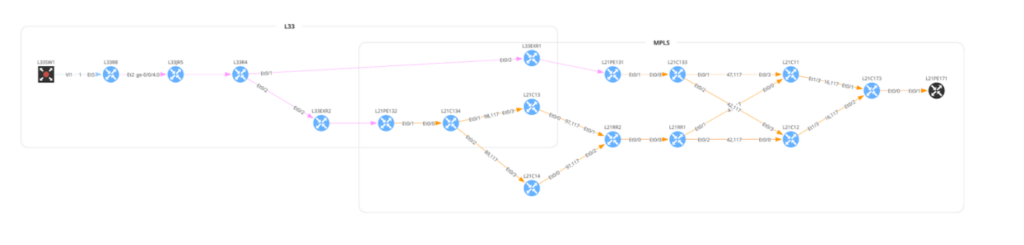
IP Fabric maps end-to-end traffic paths across your hybrid cloud. It visualizes these paths in a single, consolidated network topology, helping teams spot single points of failure and ensure that services stay available.
2. Payment and Settlement Systems: Avoiding Bottlenecks
At the heart of the financial system, payment platforms handle interbank transfers, global settlements, and retail transactions. According to McKinsey, the cost of settlement failures can reach $1 billion annually across major financial institutions.
So let’s assume a 6-hour outage as our baseline scenario, which adds up to a $1 billion annual loss (spread across incidents). IP Fabric has a customer which saw a 98% improvement in their Mean Time to Resolution, or MTTR. Taking this into account, a 98% improvement would mean just 7.2 minutes of network downtime. Instead of losing $1 billion, there would be a savings of $980 million.

3. Regulatory Compliance: Avoiding PCI Penalties and Protecting Reputation
Compliance with the Payment Card Industry Data Security Standard (PCI-DSS) is a requirement for financial firms handling payment card data. A network misconfiguration or breach of cardholder data can lead to significant fines, loss of reputation, and operational setbacks.
According to the Ponemon Institute, the cost of non-compliance can be nearly 3x higher than the cost of maintaining compliance to begin with. For global financial enterprises, penalties for non-compliance can range from $5,000 to $500,000 per month depending on the severity and duration of the violation. More specifically, breaches involving cardholder data can lead to fines up to $100,000 per incident, along with remediation costs and legal fees.
These costs demonstrate just how essential it is to have visibility and control over your network. IP Fabric helps teams do exactly that by delivering:
- Automatic network discovery and mapping from end to end—no manual configuration required. While traditional monitoring and ITAM tools rely on SNMP and static inputs, IP Fabric discovers your network the way a network engineer would, only in a fraction of the time, and with none of the error.
- Time-based snapshots that give you a point-in-time view of your network. You can track changes, identify deltas between snapshots, and pinpoint exactly when and where something shifted—helping you catch issues before they escalate.
- Over 160 built-in intent checks—and custom intent checks—to stay ahead of configuration sprawl, flag end-of-life hardware, and highlight policy violations across a multivendor environment.
- Multi-view dashboards to monitor compliance and provide actionable reports in a click. IP Fabric customer, Airbank, was able to reduce their audit workload from 30 days to 30 minutes.
Let’s go further on this last example: without automated compliance workflows, a team of 25 engineers at an average of $72/hour would spend about $432,000 in time and labor. With IP Fabric, the same task cost just $900—a difference of over $430,000.
“This investment in IP Fabric will return in less than six months… We recommend this tool to all financial service organizations that require regular audits & reporting.”—Senior Leader at Airbank
4. Network security: Defending Against Breaches
Financial institutions face escalating cybersecurity threats, with many—including Goldman Sachs—now naming cybersecurity as a top strategic priority in their annual reports. The urgency is well-founded: according to a recent IBM report, the average cost of a data breach in the financial sector is $5.9 million.
Financial institutions need more than firewalls and endpoint protection to defend themselves against these threats. True defense starts with understanding how your network is built and where it’s most vulnerable. That’s where IP Fabric comes in. It strengthens security by exposing hidden vulnerabilities, validating configurations, and delivering end-to-end visibility across the critical paths your sensitive data takes. Built-in intent checks also surface newly published CVEs and highlight which devices require patching, helping teams act quickly and proactively to keeps their networks secure and resilient.
Network Assurance for Your Financial Enterprise
When network downtime hits the financial sector, the impact reaches far beyond IT. It can disrupt services, stall trading operations, and cause compliance violations. But the true cost goes beyond lost revenue—it includes reputational damage, eroded client trust, and regulatory penalties that can linger for years.
As financial enterprises scale, IT environments are becoming more complex, with hybrid cloud architectures, multivendor ecosystems, and increasingly strict compliance requirements. Visibility isn’t a luxury—it’s a necessity.
Meanwhile, IP Fabric delivers network assurance that empowers every enterprise to work from a shared source of network truth. With full visibility into network topology, real-time path simulations, and intent-based checks, teams can resolve issues faster, prevent outages, and stay compliant without the manual overhead.
Are you confident your network can keep pace with the demands of modern finance? Try a self-guided demo with IP Fabric, or take 5 minutes to learn more about the business impact of network visibility on our blog.