
 Blog
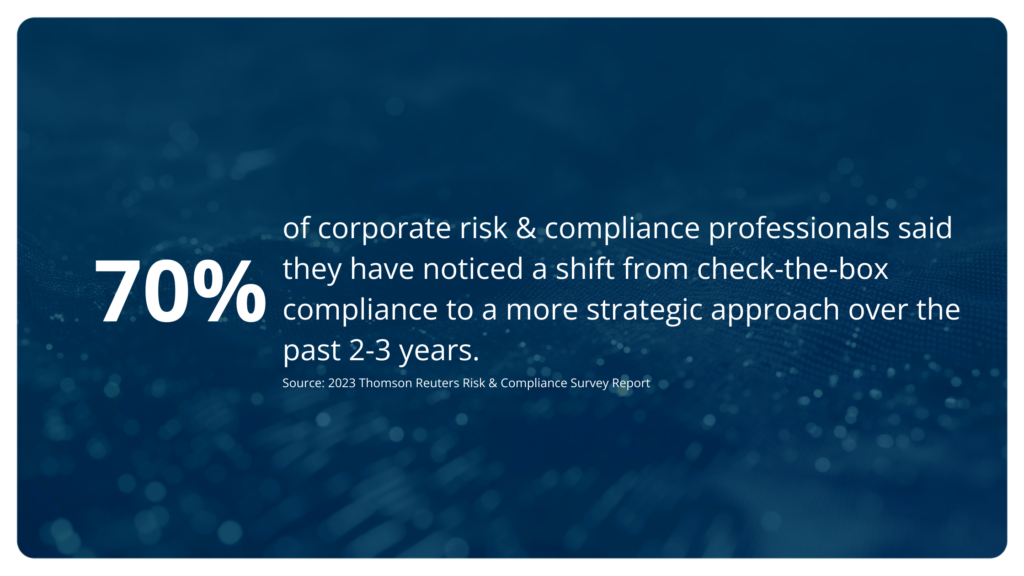
Blog Just because the evolving technology compliance burden in highly regulated industries is expected and necessary to protect consumers and industries, doesn’t mean it’s not still a costly, difficult disruption to day-to-day operations. With many service enterprises having to meet the growing demands of up to six regulatory mandates or frameworks, enterprises often find themselves embroiled in a complicated web of evidence collection, documentation, reporting, and scrambling to keep up with disjointed box-tick processes. All collected, analyzed, and collated manually. (Source: Coalfire Compliance Report)
The threat of monetary fines and reputational damage from failed audits looms large, not to mention the actual holes in operational stability and security teams discover on the way. The global average cost of a data breach rose to USD 4.45 million in 2023 (Source: IBM). And it goes beyond financial damage – in many cases, just for the EU’s Digital Operational Resilience Act (DORA), those in management positions can be held criminally liable for non-compliance.
When it comes to the IT network, C-Level technology leaders will sheepishly admit they simply can’t with certainty say what’s in their network, what interdependencies are at play, and how traffic flows through their critical systems and applications.
Trying to get to these answers “the way we’ve always done” is futile. Not only are there too many moving parts (sometimes literally), but the required outcomes vary across teams. The network team cannot realistically satisfy all these requirements, leading to mismatched expectations and frustration.
The complex and dynamic nature of enterprise networks underpinning critical infrastructure requires a level of automation to:
- Get the truth about the network, and therefore, the business
- Enable strategic business transformation and
- Inject trust into your IT foundation.
Must-Have Network Intelligence for Compliance Audits
We posit that across various frameworks (for example, the aforementioned DORA, NIS2, NIST2.0, PCI Compliance) there are repeated themes regarding network understanding requirements. For ease, we’ve placed these in 3 categories:
Assets
Discovery: Complete discovery of network assets to provide an inventory of knowns and unknowns.
Scope: Establishing the boundaries of the network-identifying borders beyond which third parties, ISPS, etc manage adjacent infrastructure.
Lifecycle: Show that you can determine when owned and managed assets are EOS, EOL, EOM.
Hardening: Validate configuration standards are applied.
Vulnerabilities: Demonstrate that you’re checking against the NIST CVE database.
Interdependencies
Map Topology: Build a trustworthy view of the network that changes with it.
Segmentation: Validate the extent of network segments and policy enforcement between them.
Traffic Flows
Record Critical Service Paths: Show that you understand how services are dependent on network infrastructure client to workload.
Validation Of Business Continuity: Show that services will continue to function after Disaster Recovery invocation.
It’s not enough to collect this information once and be done. In fact, it’s made clear in several regulations that this information should be continuously updated whenever change is applied. Dusting off 6-month-old network documentation to illustrate asset inventory, security policy application, or your business continuity plans simply won’t meet the stringent standards, for example in NIST 2.0 implementation examples under the Identity function subcategory Asset Management (ID-AM):
- Ex3: Identify unofficial uses of technology to meet mission objectives (i.e., shadow IT)
- Ex4: Periodically identify redundant systems, hardware, software, and services that unnecessarily increase the organization’s attack surface
- Ex5: Properly configure and secure systems, hardware, software, and services prior to their deployment in production
- Ex6: Update inventories when systems, hardware, software, and services are moved or transferred within the organization
The same is true for DORA: “Financial entities shall, on a continuous basis, identify all sources of ICT risk, in particular the risk exposure to and from other financial entities, and assess cyber threats and ICT vulnerabilities relevant to their ICT supported business functions, information assets and ICT assets.” (Article 8.2)
Static documentation is not sufficient. Your compliance management tooling must be as dynamic, flexible, and adaptable as your network itself and the changing cybersecurity threat landscape.
Network Assurance as a Compliance Management Tool
IP Fabric’s automated network assurance provides all the necessary network intelligence to automate network compliance, and prove this across a range of frameworks and regulations. Let’s look at how you can achieve the peace of mind to welcome network audits, knowing that you’re audit-ready every day.
1. Assets
Understanding what you’re trying to secure or make compliant is essential to any compliance program; without accurate overall visibility into your IT network assets, you’re operating from ignorance and there are likely unmanaged and unmonitored network devices causing vulnerabilities.
a) Network & Cloud Discovery
IP Fabric uses a secure and comprehensive CLI-based discovery mechanism to collect detailed information about your network environment. This process is light on resources and works like a network engineer would, using SSH or API calls to understand device neighbor relationships hop by hop to build a vendor-agnostic view of your network.
You choose how often to discover the whole of (or just specific parts of) your network, likely multiple times a week or even daily, should you choose so.
Security or service management tools may include network discovery capabilities, but the accuracy and detail collected often falls short of expectations. This leaves network engineers to fill critical gaps manually, requiring extensive effort to extract the necessary value from these tools with bolted-on discovery mechanisms.
b) Audit Scope
Properly scoping how critical data flows through your network can save huge headaches when it comes to audits. Understanding, for example, where in your network Card Holder Data traverses, can help you limit the scope of a PCI audit, reducing associated expenses and effort.
c) Device Lifecycle
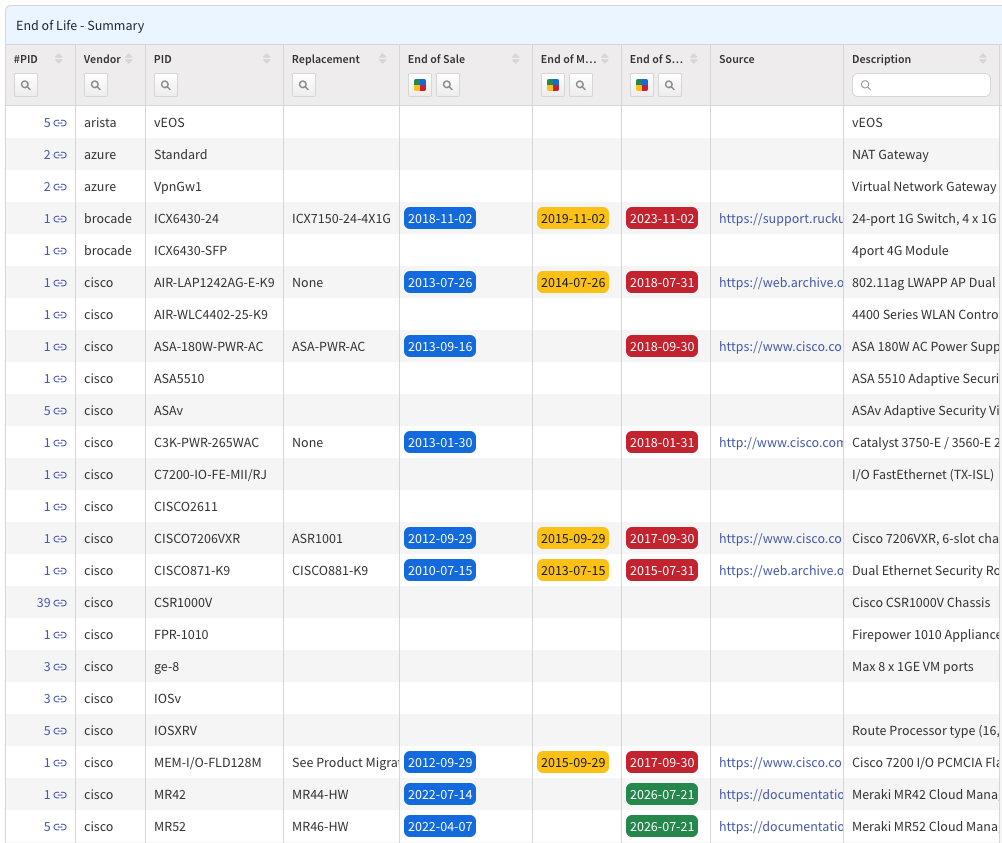
Access to up-to-date End-of-Management, End-of-Support, and End-of-Life device information, as well as replacement suggestions, dramatically reduces network planning time and allows for proactive discussions about future-proofing and budgeting for architecture changes. This means you have a head start on business continuity plans no matter what your technology providers decide. Evidence of business continuity plans is key to multiple regulations and security frameworks, such as PCI DSS Requirement 12.3.4:
“Hardware and software technologies in use are reviewed at least once every 12 months, including at least the following:
• Analysis that the technologies continue to receive security fixes from vendors promptly.
• Analysis that the technologies continue to support (and do not preclude) the entity’s PCI DSS compliance.
• Documentation of any industry announcements or trends related to a technology, such as when a vendor has announced “end of life” plans for a technology.
• Documentation of a plan, approved by senior management, to remediate outdated technologies, including those for which vendors have announced “end of life” plans.”
d) Hardening
Beyond knowing what you have and where it is, you must understand how network devices are being managed, and central to this is how devices are configured to protect against attack. Understanding and automatically documenting the reality of this in your network means you can prove that you’re running a sufficiently resilient operation.
NIST’s Detect function requires vulnerability scans to be performed (DE.CM-08).
e) Vulnerabilities
IP Fabric uses published vulnerability data from the Common Vulnerabilities and Exposures (CVE) programme and compares it with your observed network information. This lets you identify impacted devices, understand the impact of upgrading or replacing devices by demonstrating their role in your network topology, and exposes the overall impact of the issue within your network.
See more: Network Infrastructure Security with IP Fabric
f) Backups
Once again, most compliance regulations that care about the network consider business continuity a key concern, and you must have evidence of your continuity plans. IP Fabric lets you easily prove that you’re storing configuration backups for devices so they can be restored to new devices in case of failure.
2. Interdependencies
Network devices don’t exist in a vacuum; your network is like a living organism, with each action influencing the devices around it. Understanding and documenting these relationships is the bread and butter of IP Fabric, as we build our network model by interpreting neighbor device behavior. It’s also crucial for various compliance regulations, as auditors want to see an understanding of the holistic behavior of your IT estate; okay, so your switches are hardened against attack – but is your whole network sufficiently resilient as the technical foundation of your business?
g) Map Topology
IP Fabric’s automatically generated, flexible network topology maps provide a dynamically updated understanding not just of how devices are managed, maintained, and operated, but how this effects the network as a whole. You can choose what you want to see in these topology maps and share relevant views with the teams that need them.
Since understanding the architecture of critical infrastructure, right down to the physical layer, is so important for a multitude of regulatory frameworks, having this updated and available on-demand completely changes how network teams preparing for audits operate.
h) Network Segmentation
Using network segmentation, or even micro-segmentation, to separate and secure discrete parts of your network is necessary to fulfill certain requirements of PCI-DSS4.0, for example, Requirement 1.4.4: “System components that store cardholder data are not directly accessible from untrusted networks.” Additionally, NIST2.0 requires under the Protect function that “Access permissions and authorizations are managed, incorporating the principles of least privilege and separation of duties” (PR.AC-04) and under Respond that “Incidents are contained” (RS.MI-01).
DORA also emphasizes the implementation, maintenance, and validation of strong access control and segmentation policies (Article 9.2, Article 9.4).
IP Fabric provides the means to continuously validate that segmentation policy enforcement points are operating as expected, revealing any unwanted change quickly so you can take remediation action as appropriate.
3. Traffic Flows
i) Record Critical Service Paths
IP Fabric uses the source and destination address to automatically generate end to end network paths visualization, eliminating repetitive and error-prone manual work to record how critical traffic traverses your network.
PCI Requirement 1.2.4 demands that “an accurate data-flow diagram(s) is maintained that meets the following:
• Shows all account data flows across systems and networks.
• Updated as needed upon changes to the environment.”
Similarly, DORA requires that you model data flows to identify critical paths and ensure security controls are in place (Article 9.2, Article 11.5) and NIST requirement ID.AM-03 states that “Representations of the organization’s authorized network communication and internal and external network data flows are maintained.”
Having this available not only ticks a checkbox for multiple regulations but can be inserted into trouble tickets to lower Mean Time to Resolution (MTTR).
j) Validation of Business Continuity
Use the interactive visualization of your network to continuously validate and prove that the resiliency and redundancy measures you have in place. Pre- and post-change validation that all traffic flows are operating as expected based on network intent rules means peace of mind for network and security teams managing a dynamic network.
This empowers your team with the knowledge that in the case of a hardware failure, or vulnerability exploitation, your critical functions will continue to run smoothly, minimizing the impacts of network incidents on the business.
This is crucial for NIS2 Compliance, which requires you to “Develop plans for business continuity, including backup management, disaster recovery, and crisis management, to ensure business operations can continue during and after cyber incidents” (Chapter IV, Article 21).

Conclusion
Establishing an automated way of acquiring and validating network intelligence not only stabilizes your daily operations by giving you team back time and peace of mind, but also sets the stage for transformational strategic projects. These business-wide initiatives require a basis of trust to build upon, and assurance that you’re meeting security frameworks and regulations is confirmation of the operational resilience of your network.
Network assurance will change the way you operate, maintain, and transform your network. To see IP Fabric automated network assurance platform for yourself, try our self-guided demo here.