
 Blog
Blog Imagine this: You’re preparing for your next PCI DSS audit, and your diagram says one thing, but your actual network behavior is saying another.
Maybe a device dropped off your inventory, or didn’t get the proper security patch. Maybe a segmentation policy drifted from your intended design, allowing PCI data to leak into other environments. Each of these gaps can increase your risk—not to mention add days of work to your audit preparation.
Rest assured, this blog will cover key PCI DSS controls as well as the proven strategies you need to meet them. But first, let’s dive into the basics of PCI DSS compliance.
Who Is Required to Meet PCI DSS Compliance?
Put simply: if your organization processes, stores, or transmits PCI data, then you must adhere to PCI DSS. This standard encompasses global industries like banking, trading, insurance, and retail, just to name a few.
Within an organization, compliance is a shared responsibility across NetOps, DevOps, IT, legal, and executive teams. It’s important for each of these teams to operate from a shared source of network truth so that they can work together to maintain the rigorous security posture that PCI DSS demands.
Who Enforces PCI DSS Compliance?
The PCI Security Standards Council (PCI SSC) is responsible for “developing and maintaining” PCI DSS, but they are not responsible for enforcing it. Instead, PCI DSS is enforced by the founding members of the council, which includes major financial institutions like American Express, Discover, MasterCard, and Visa.
How Much Do PCI DSS Fines Cost?
If an organization fails to meet PCI DSS requirements, they can see legal action as well as fines that can span from $5,000 to $50,000 per month. This wide range is due to a number of factors, including the nature and extent of the violation in question.
Compliance costs extend far beyond fines, though. If an organization fails to implement PCI DSS controls, and suffers a breach because of it, they may be looking at an additional $5.56 million as well as lost revenue from downtime and processing delays.
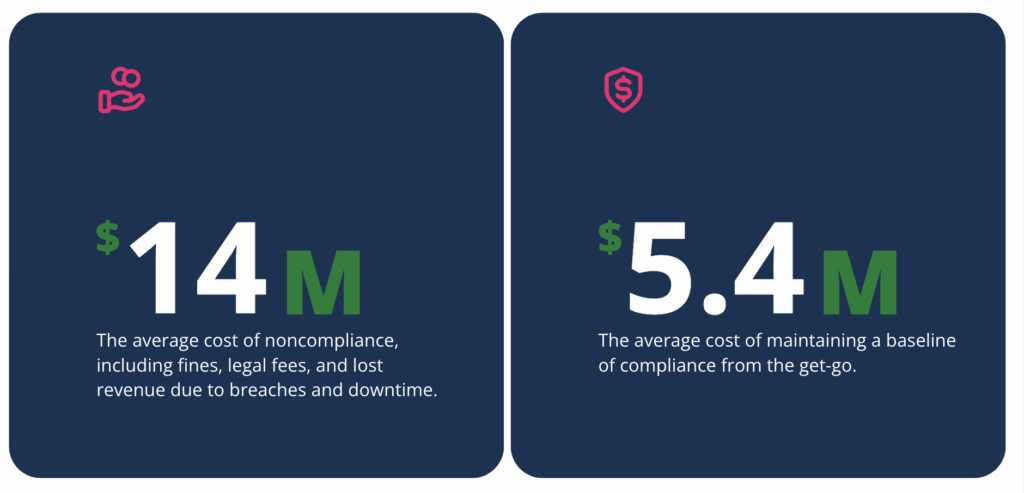
Noncompliance is nearly 3x more expensive than the cost of maintaining compliance.
What Are Key PCI Controls?
PCI DSS guidelines cover several aspects of data handling, from inventory management to network governance and reporting. These requirements are so comprehensive that many organizations use them to guide their overall security strategies. (After all, PCI DSS has stricter requirements and steeper penalties than voluntary standards like NIST 2.0 and ISO 27001.)
Inventory Management
As the saying goes, “You can’t secure what you can’t see.” You need to have a complete and accurate view of your inventory in order to flag unpatched devices, misconfigured firewalls, or bypassed security controls that might otherwise slip through the cracks. In order to prevent these oversights, PCI requires organizations to:
- Keep a current inventory of all devices and system components.
- Maintain a diagram of data flows across the cardholder data environment (CDE) and all connected systems.
The only way to meet these requirements? Ensuring that you have complete visibility across your cloud, security, and network infrastructure. This visibility also comes in handy for identifying—and promptly addressing—any risks that may arise.
Governance
PCI DSS outlines several proactive and reactive measures for robust infrastructure governance. For instance, the standard advises organizations to preemptively address the following risks:
- Unpatched or unsupported devices.
- Unnecessary traffic or system access to the CDE.
- Bypassed or misconfigured firewalls between trusted and untrusted networks.
- Misconfigured access controls.
With an established risk mitigation process in place, organizations not only shrink their attack surface, but also limit the lateral movements of an intruder, should a breach occur.
Reporting
Without proper reporting mechanisms, organizations may struggle to demonstrate their security posture during audits or investigations. PCI DSS requires organizations to:
- Retain audit trail history for at least one year.
- Keep a minimum of three months of documentation available for analysis.
This historical data is useful for simplifying compliance audits, as well as for maintaining a record of the network’s “last good state” to assist in recovery after an incident.
Visit our compliance hub and download our compliance e-Book.
What Tools Can Help Meet PCI DSS Compliance?
The average enterprise juggles a whopping 130 security tools, including CMDBs, policy platforms, and more. Each tool may provide valuable insights about a specific part of the network, but the overall patchwork creates critical blind spots.
Automated network digital twin platforms like IP Fabric fill any gaps by mapping all devices, connections, and configurations to create a complete network digital twin. This digital twin offers normalized insights that any team can use to proactively identify and address risks before they can result in breaches or noncompliance.

Learn how to improve your observability tool with a network digital twin.
How Does a Network Digital Twin Tool Help to Prove PCI DSS Compliance?
Now that we’ve covered the key PCI DSS requirements, let’s see how IP Fabric’s network digital twin platform helps organizations put them into practice.
Inventory Management
IP Fabric captures time-based snapshots of your infrastructure behavior, which can be run up to several times per day. These snapshots:
- Automatically discover, map, and document the infrastructure from core to cloud to edge.
- Gather an accurate, up-to-date inventory of devices.
- Can be synced with ITSM tools, CMDBs, and more to maintain unified network visibility across teams.
With these comprehensive insights, you have all the context you need to quickly identify, prioritize, and remediate risks when they arise.
What does total network visibility look like? See for yourself in this 20-minute webinar.
Governance
IP Fabric helps organizations stay ahead of evolving risks through proactive testing and policy enforcement. The platform:
- Runs a series of compliance checks to flag any places where your network behavior deviates from intended PCI controls.
- Compares devices against publicly available vendor information to spot critical End-of-Life (EoL), End-of-Support (EoS), and End-of-Maintenance (EoM) milestones.
- Automatically creates an ITSM ticket if the network deviates from business intent.
In the event of a data breach, your team can reference recent snapshots and end-to-end path lookups to investigate the root cause before moving swiftly to address it.
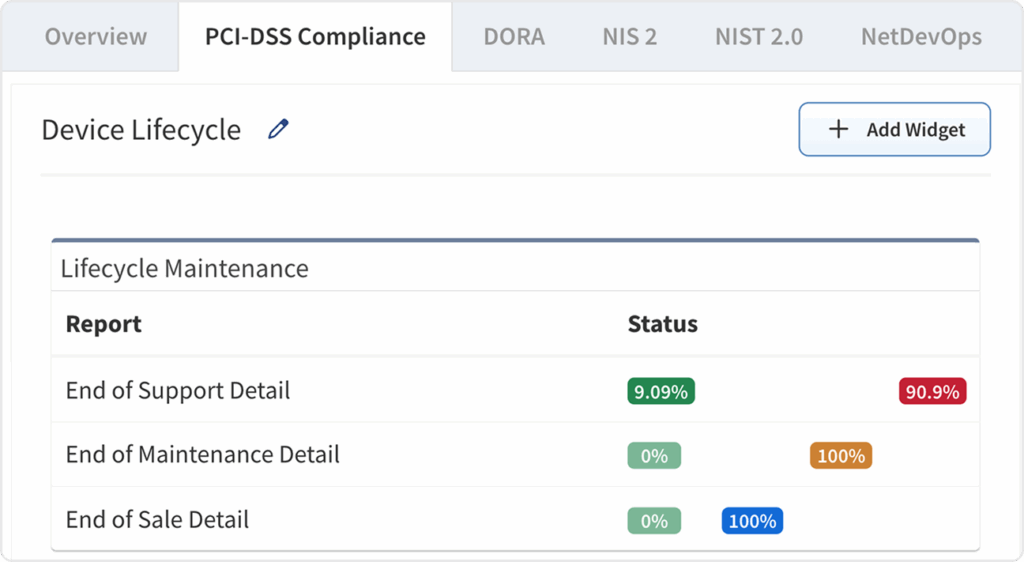
Automate PCI validation to meet evolving PCI DSS controls.
Reporting
Audit preparation shouldn’t require weeks of manual documentation. IP Fabric solves this problem by maintaining comprehensive compliance reporting. The platform does this in two key ways:
- Retaining a historical audit trail of recent snapshots and compliance checks.
- Delivering the results of compliance checks in custom multi-view dashboards.
Whether you’re looking for robust audit documentation or an executive summary about your network security posture, IP Fabric offers normalized insights in just a few clicks.
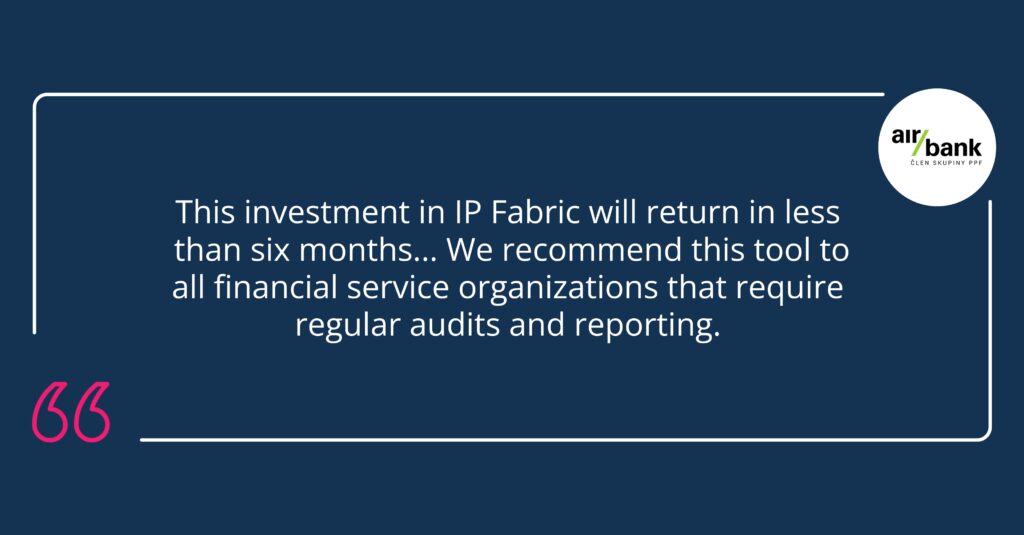
Air Bank reduced their PCI audit prep from 30 days to 30 minutes. Get the full story.
Can You Automate PCI DSS Compliance?
Your infrastructure is always changing. New devices come online, configurations drift, and vulnerabilities emerge by the day. Manual compliance tracking simply can’t keep up with the pace of change at the enterprise scale.
IP Fabric solves this by continuously tracking your assets, monitoring your configurations, and maintaining documentation. In other words: no missing our inaccurate data. As your infrastructure grows and evolves, IP Fabric adapts with it, ensuring PCI DSS standards are met and proven without manual oversight.
Tune in to our compliance webinar series for tips on automating PCI validation.
Are You Ready For Your Next PCI DSS Audit?
With the right network digital twin platform, you can approach audit season knowing that you’re in complete control of your infrastructure.
Ready to learn more? Tune in to our 20-minute webinar for further insights on how you can close compliance gaps, accelerate audits, and protect cardholder data with confidence.