
 Blog
Blog In 1736, Leonhard Euler presented “The Seven Bridges of Königsberg,” a now-famous proof in mathematics. Euler tried to determine if it was possible to walk across the city, crossing each of the seven bridges only a single time. It wasn’t.
Euler’s efforts helped birth graph theory as a new field of mathematics. It also laid a foundation for topology, a cornerstone of modern computer science and networking that helped model everything from the internet to social networks.
Fast forward to today, when networks are struggling to keep pace with the insatiable demand for AI. Euler’s proof reminds us that specific tasks may be impossible in current conditions. Sometimes, understanding that no efficient (or possible) solution exists within certain conditions can be just as important as finding one that does.
I bring this up because companies are being pressured to “stay competitive” or “gain efficiencies” by implementing AI. But the rush often distracts from execution. Poor implementation not only erodes trust but also has critical consequences on network operations.
According to an MIT report on “The GenAI Divide,” AI is failing spectacularly in the enterprise. Despite spending $40 billion on AI, only 5% of enterprises are seeing a return on investment for their initiatives.
When you get past the hype, it’s easy to see how the cascade of failures occurred. AI models are only as good as the data used to train them; if you’re relying on incomplete or outdated network data, your AI model is likely to blame.
Many CEOs aren’t confident that their data is ready to fuel desired AI outcomes. In my two decades of experience building some of the largest global networks, I’ve seen instances where 20% to 40% of what’s in a configuration management database (CMDB) is incorrect. In these cases, it not only means that a substantial portion of the network inventory is unmanaged, but also that companies are missing vital context about how different parts of the network depend on each other to deliver critical services.
This lack of context can put the business at risk, making it difficult to troubleshoot and remediate issues when they inevitably arise. And while the term “AI slop” has come to typically reference effortless digital content made with AI, I find it appropriate to mark this kind of context-free automation with the label as well. To address this AI slop problem, we must first find a way to close the gaps in our understanding of network behavior.
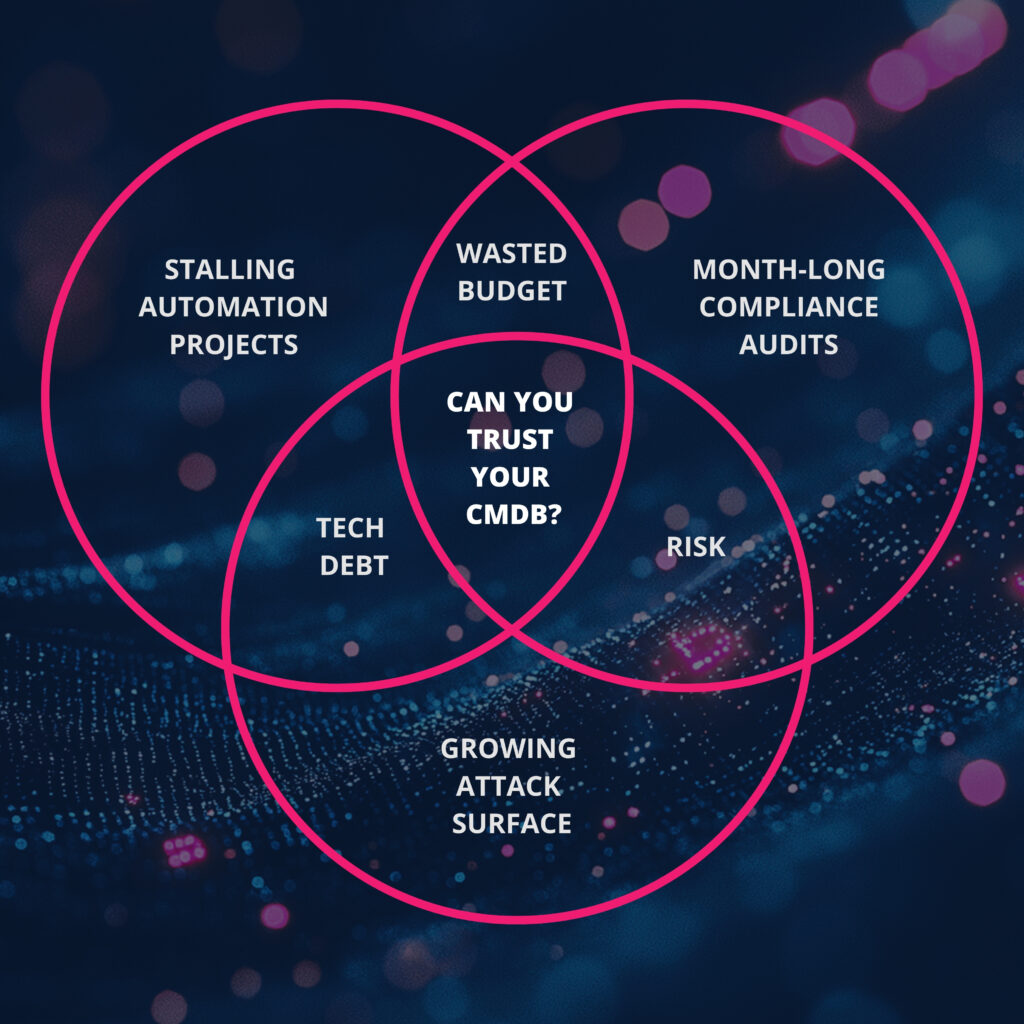
Can you trust your CMDB? Learn how to improve your CMDB accuracy for smoother network operations.
What Can Enterprises Do to Build More Reliable Network Operations with AI?
There’s no doubt that AI can deliver a plethora of benefits. But at the same time, the lack of AI’s success at the enterprise level shows us that if you quickly and broadly deploy any technology regardless of context, it’ll likely result in slop. But it doesn’t have to be that way.
Let’s walk through a few of the steps you can take to optimize AI adoption in your enterprise environment.
Improve Data Quality with Network Digital Twin Technology
Enterprise networks are complex and ever-changing. Even before the advent of AI, most outages or breaches could be attributed to gaps in monitoring, as well as a broader lack of context for network behavior. Periodic system and documentation updates aren’t enough to pick up on deltas between your network’s intended state and your actual state. In other words, at the enterprise level, it’s impossible to keep up with changes manually.
Approaches such as network digital twins offer an automated route to resolve this problem by building a virtual replica of your entire digital infrastructure. This helps to deliver an accurate and complete look at your actual network behavior at a given point in time, which can be used as a reliable baseline for ensuring smooth operations and service delivery.
Digital twins should be integrated throughout the observability stack and used as a foundation for automated workflows. This ensures incoming data is accurate and that automated workflows are aligned with business intent, while maintaining a segregation of duties for robust governance.
Trust Human Domain Expertise to Validate AI Behavior
Technology helps deliver fresh, accurate data about network devices and dependencies, but only human domain experts have the knowledge and context needed to ensure it’s being used correctly.
For example, automation has such an outsized effect on network operations that it’s essential to keep a human domain expert in the loop until trust and value are established. Operationally, this domain expert—or team of experts—should have ownership over training and evaluating AI projects, with the goal of ensuring security, compliance, and efficiency.
Only Integrate AI Where It’s Needed Most
If you’re like most CEOs, you may believe that AI agents will create new departments in organizations. That’s fine, as long as AI isn’t a department on its own. For AI to deliver value, it cannot be siloed from the specific business operations and people it supports. There is no one-size-fits-all implementation that can be stamped across the enterprise from a single department. If AI exists on its own, expect it to act primarily for its own benefit, rather than for yours.
Finally, always keep Euler’s lessons in mind. No perfect mathematical algorithm exists for all conditions. And just because you can try to do something with AI, it doesn’t mean the current conditions exist right now to make it successful.
This article was originally published on Forbes.
Working on a network AI project? Our team is here to help! Contact us for a personalized demo today.