
 Blog
Blog Modern networks are a tangled web of systems, vendors, and tools, making them notoriously difficult to manage.
Up to 20% of the network may be unmonitored at any given time, exposing the business to critical security gaps and compliance risks. Automation and AI can address these risks, but when built on unverified datasets, they often hurt more than they help, amplifying errors and costly inefficiencies.
These compounding challenges often derail progress—and many organizations have felt the effects, with nearly half of large IT projects exceeding their budgets.
Today’s networks require more than task-based automation to solve these issues; they demand solutions that can understand and implement business intent across multi-vendor environments. These solutions must also reveal how IT metrics play a part in driving critical board-level initiatives, like opening new datacenters, fulfilling requirements for mergers and acquisitions, and achieving compliance with leading security frameworks like NIST and ISO 27001.
Gartner reports that Campus Infrastructure and Operations Software (CIOS) has the potential to do just that by addressing key areas such as campus access security, campus automation, and campus network management. However, many CIOS solutions fall short when it comes to providing support for broader automation initiatives.
Overcoming the Obstacles of Network Automation
Gaps in Governance
As the adage goes, “You can’t control what you can’t see.” The same applies to automation. Nine in ten CIOs lack a unified architecture model, cobbling together multiple observability and monitoring tools for a patchwork view of their network. This fragmented approach is riddled with visibility gaps, making it possible for misconfigurations and unapproved network changes to slip through unnoticed. Similarly, EMA reports that 91% of network automation strategies depend on multiple tools, adding further layers of complexity that hinder teams from building accurate, efficient automation frameworks.
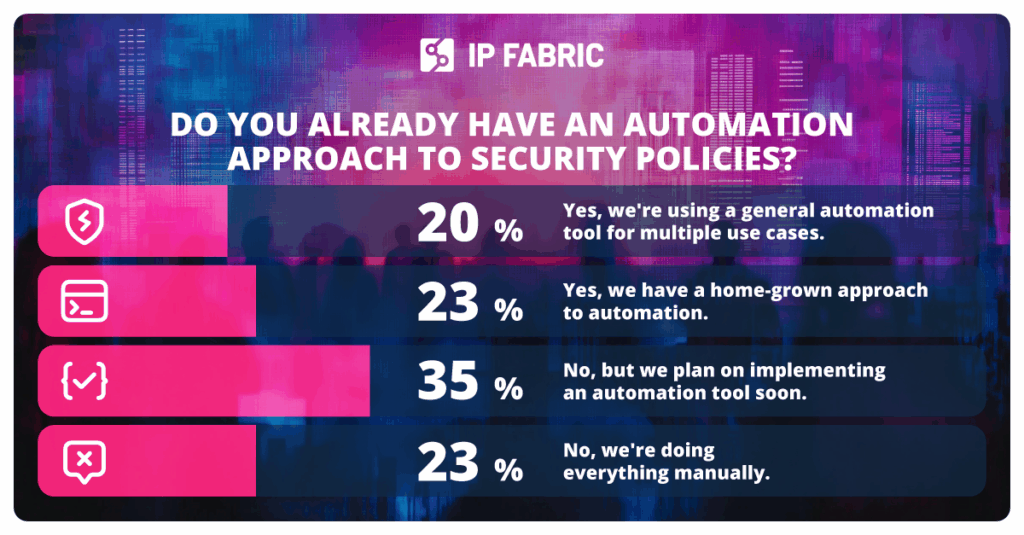
In a recent poll, IP Fabric found that only 20% of respondents were using a unified automation tool.
Without a clear understanding of network behavior—and a verified dataset to go with it—automation and AI initiatives can cause a cascade of errors across the network. Misconfigurations, hallucinations, or unapproved changes can lead to costly breaches, noncompliance fines, outages, and other unintended consequences. These issues not only generate unbudgeted expenses, but also put the reliability and reputation of the business at risk.
Lack of Trust
With such high stakes, it’s understandable that IT leaders may be skeptical of automation. As with any change, changes powered by AI and automation must be validated to ensure they’re not aggravating existing problems instead of fixing them.
This is where Segregation of Duties (SoD) comes into play. SoD creates a system of checks and balances that prevent any single solution from acting without oversight, stopping risks like erroneous configurations or mismanaged workflows from propagating throughout the network.
For instance, a forward-thinking organization may implement a network digital twin solution that can expand visibility and suggest changes to address any risks to security or compliance. This solution should integrate closely with IT Service Management (ITSM) tools for ticketing and workflow approval, as well as with automation solutions like Ansible, Itential, Python, or Terraform.
“Why can’t one tool do it all?” you may ask. The answer is simple: keeping these tools separate ensures that validation remains objective. It adds a critical layer of accountability to confirm that your automation solution is delivering reliable and predictable results that are aligned to business interests.
Transforming Network Automation
Enter IP Fabric: a leader in network digital twin technology. The platform’s digital twin capabilities provide a 100% accurate and complete view of the network, giving organizations an unprecedented ability to anticipate and control network behavior.
Complete Network Discovery
Using CLI commands and API calls, IP Fabric maps and analyzes every device and connection across the hybrid multicloud environment. This process also identifies unmanaged, unpatched, and End-of-Life (EoL) or End-of-Service (EoS) devices that traditional CMDBs and observability tools might miss.
Equipped with this complete inventory, IP Fabric creates a “digital twin” to visualize and simulate network behavior. This capability can be used to continuously validate that security controls like microsegmentation, firewall rules, and Access Control Lists (ACLs) are configured as intended throughout the network.
Vendor-Neutral Insights
IP Fabric democratizes network data with normalized, vendor-neutral insights. From automation engineers to IT leaders, anyone who needs context into network behavior can access it through a user-friendly GUI as well as seamless API integrations. By paving the way to self-serve workflows, IP Fabric helps businesses to break down data silos for smoother, faster collaboration.

Monitor the results of intent checks in custom, multi-view dashboards.
Customizable Reporting
End-to-end path lookups and on-demand snapshots offer a timestamped record of your network, serving as audit-ready evidence of ongoing compliance for all major security frameworks and regulatory standards.
After running intent checks across millions of network datapoints, IP Fabric tracks the results in multi-view dashboards. These dashboards can be used to monitor and share insights about network health, security posture, compliance, and more.
To cater to hyper-specific business needs, IP Fabric also provides the option to create custom intent checks and dashboards without needing advanced knowledge of query or coding languages.
Robust Network Automation and AI Governance
IP Fabric strengthens digital transformation initiatives through deep integrations with automation tools like Nautobot, Ansible, and ServiceNow. Delivering highly contextualized and normalized insights, the platform ensures every automated action is informed by the most up-to-date state of the network.
With the ability to simulate network behavior, organizations can validate automation both before and after changes are made, thereby minimizing the likelihood of risks or unintended disruptions. This assurance is the key to providing a stable, secure, and compliant foundation for scaling network automation and AI-driven innovation.
Understanding the Business Impact of Network Automation
Avoid Unbudgeted Spending
IP Fabric provides the assurance IT teams need to avoid costly breaches and prove compliance with regulatory standards.
By automatically validating and enforcing security controls, IP Fabric reduces the risk of data breaches and ransomware, which can run $4.88 million and $2.73 million apiece. (Not including the post-breach hike in cybersecurity insurance rates.)
Noncompliance with regulations can be similarly costly, with HIPAA violations averaging $50,000 per incident. All in all, noncompliance is nearly 3x more expensive than the cost of maintaining compliance.
IP Fabric builds regulatory compliance into all operational workflows, deploying automated intent checks for businesses to ensure that their network behavior is aligned with security best practices, regulatory requirements, and their own unique policies.
Speed Time to Market
Launching a new app? Migrating to the cloud? Closing a merger or acquisition? McKinsey research shows that being just six months late to market with a new product or service can lead to 33% less profit over five years. IP Fabric helps organizations to avoid this hidden cost by ensuring network security and stability during digital transformation initiatives—without delaying delivery.
On top of minimizing risk, IP Fabric also unlocks opportunities to drive sustained revenue growth. By empowering IT teams to manage network and operations at the speed of business, IP Fabric helps to reduce churn and enhance the overall customer experience.
Confidently Govern Your Network Automation
IP Fabric is revolutionizing the way organizations approach network automation and governance, equipping them with the tools they need to uplevel security, ensure compliance, and accelerate time to market. Whether you’re tackling complex digital transformations, managing regulatory mandates, or driving operational excellence, IP Fabric provides the visibility and intelligence to tether IT initiatives to business goals.
Ready to see IP Fabric in action? Try our self-guided demo, or contact our team for more information.