


The network management landscape is transforming, thanks to the integration of artificial intelligence (AI) and chatbots. IP Fabric is at the forefront of this innovation, showcasing how conversational AI can empower network professionals to interact with complex network data effortlessly.
In a recent webinar, we demonstrated how to use the power of Large Language Models (LLMs) and the Llama Index framework to create a user-friendly chatbot interface for network data retrieval. Traditionally, accessing specific network information required knowledge of intricate API queries or commands. The chatbot allows users to ask questions in plain language and receive accurate, contextually relevant answers.
Conversational AI: The Key to Unlocking Insights
Traditionally, retrieving information from network data involves constructing complex API queries or sifting through dashboards. Conversational AI simplifies this process by allowing you to ask questions in plain language, just like you would ask a colleague. The AI then translates your questions into the appropriate queries, returning relevant information in a user-friendly format.
Building a Network Data Search Engine
To create our conversational AI-powered network data search engine, we integrated a language model with IP Fabric. Language models are AI algorithms trained on massive amounts of text data, enabling them to understand and generate human-like language. In our case, the language model acts as the "brain" of our search engine, interpreting questions and retrieving answers from IP Fabric.
JSON Query Engine
The JSON query engine is useful for querying JSON documents that conform to a JSON schema.
The JSON query engine, often used within frameworks like LlamaIndex, is a tool designed to streamline the process of extracting information from JSON data. JSON (JavaScript Object Notation) is a standard format for storing and exchanging data, commonly used in web applications and APIs.
How does it work?
The JSON query engine leverages the structure of your JSON data, often with the help of a JSON Schema. This schema acts as a blueprint, outlining the hierarchy and types of data within your JSON files.
Here's a simplified breakdown of the process:
Input: You provide the JSON query engine with three key elements:
- The raw JSON data you want to query,
- A JSON Schema describing the structure of your data (optional, but highly recommended),
- A natural language question you want to ask about your data.
Translation: The engine uses the schema (if provided) and its understanding of JSON structure to translate your natural language question into a structured JSONPath query. JSONPath is a query language specifically designed for navigating and extracting data from JSON documents.
Query Execution: The engine executes the JSONPath query on your JSON data, pinpointing the specific pieces of information relevant to your question.
Response Synthesis: The extracted data is then processed and presented back to you in a clear, concise, and human-readable format.
JSON Query Engine and IP Fabric data
IP Fabric's rich network data, spread across various tables like inventory, ARP, MAC, and more, is a treasure trove of insights. To unlock this potential, we consolidated this data into a single JSON file, creating a unified structure for analysis. We then designed a JSON schema, a blueprint of our data's properties, which aids our chosen language model (GPT-3.5 Turbo) in understanding and interpreting the data.
This streamlined approach empowers us to ask intricate questions about our network in plain language, receiving insightful and accurate responses powered by GPT-3.5 Turbo's advanced language capabilities.
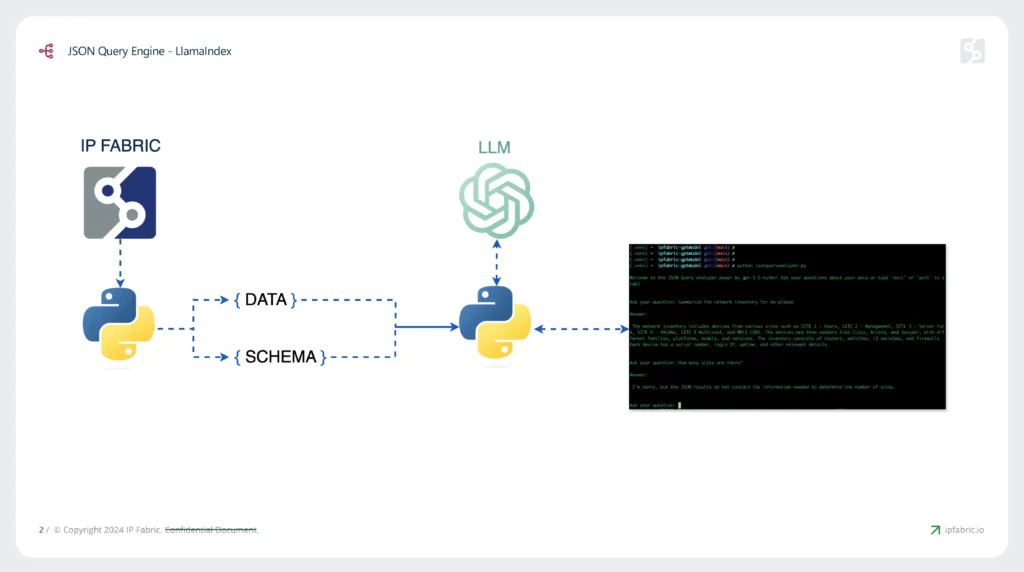
After loading the JSON and Schema, we used a simple script to create a CLI prompt:
# --- Load Data ---
data = load_data_from_json(JSON_FILE)
schema = load_data_from_json(SCHEMA_FILE)
query_engine = JSONQueryEngine(json_value=data, json_schema=schema, llm=llm)
# --- Interactive Prompt ---
print(f"\nWelcome to the JSON Query analyzer power by {OPENAI_MODEL}! Ask your questions about your data or type 'exit' or 'quit' to stop)")
while True:
question = input("\n\nAsk your question: ")
if question.lower() in ["exit", "quit"]:
break
try:
answer = query_engine.query(question)
print(f"\nAnswer:\n\n {answer}")
except Exception as e: # Consider catching specific exceptions for better error handling
print(f"\nI am sorry, I don't have the answer for you: \n{e}")
The Llama App: Your Network Data Assistant
To make our network data search engine even more accessible, we built a user-friendly interface using the Llama app. The Llama app makes it easy to set up and interact with conversational AI applications. With just a few clicks, you can start asking questions about your network data and receive contextual answers in real time.
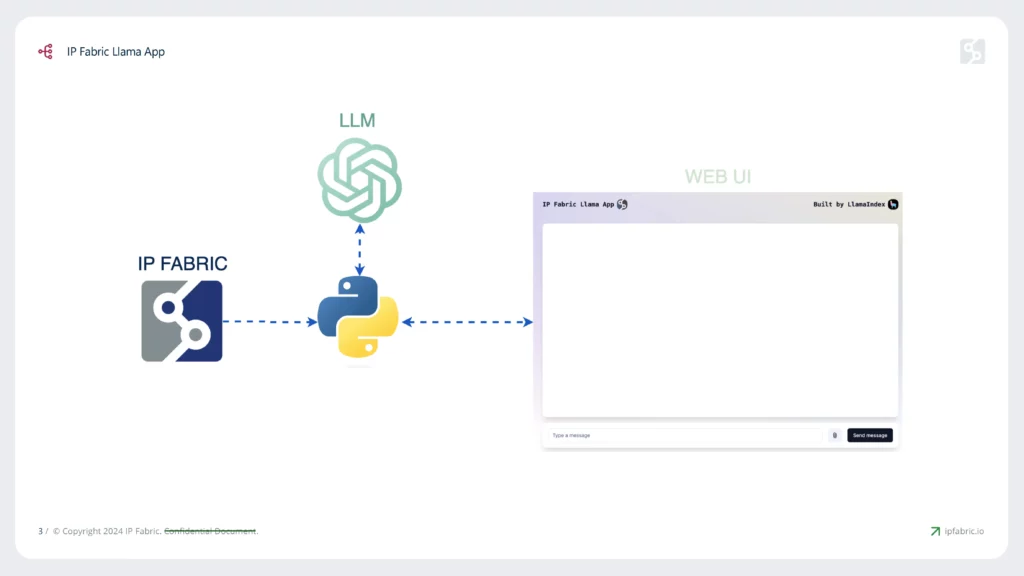
For our Llama App implementation, we opted for a streamlined approach:
Data Extraction: We exported relevant IP Fabric data directly into CSV format, bypassing any pre-processing steps.
Backend Integration: These CSV files were then loaded directly into our backend system.
Frontend Activation: After initializing both the frontend and backend components, the Llama App was fully operational, seamlessly integrating with our IP Fabric data.
This straightforward process allowed us to quickly leverage the Llama App's capabilities without the need for complex data transformations, showcasing its flexibility and ease of use.
Putting It into Action
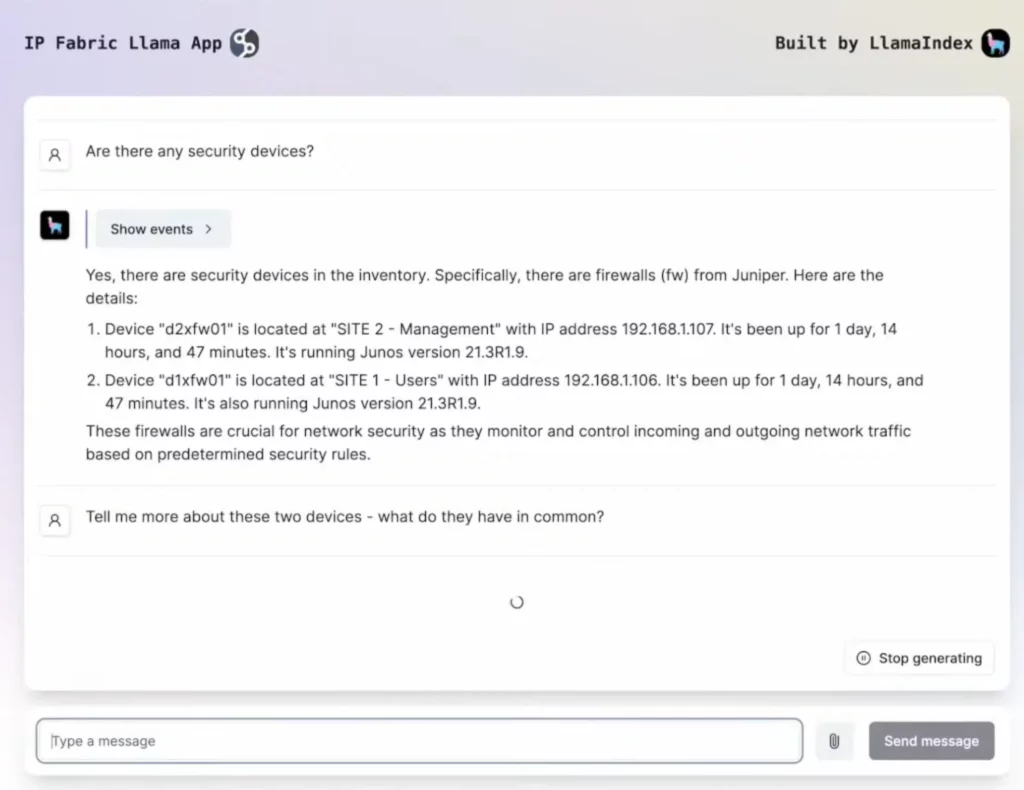
Imagine asking your network data assistant, "Can you summarize our network inventory?" or "What security devices do we have in place?" The Llama app, powered by our LLM and integrated with IP Fabric, can answer these questions and many more - providing you with the information you need to make informed decisions about your network.
Benefits and Use Cases
The benefits of using conversational AI for network data retrieval are numerous:
- Quick and accurate responses: Get the information you need in seconds, not hours.
- Increased accessibility: Empower non-technical users to access network data.
- Enhanced efficiency: Streamline information retrieval and decision-making.
- Deeper insights: Gain insights beyond what the platform offers by default.
Conversational AI has the potential to revolutionize how organizations manage their networks. Whether you're a network engineer troubleshooting an issue or a manager seeking a high-level overview, conversational AI can provide the information you need in a way that is both efficient and accessible.
Want more information?
We are reaching out to customers we know to have the affected versions in their networks.
If you are an IP Fabric customer and would like to know more, speak with your Customer Success Manager or Solution Architect for more details. And if you are not yet a customer and would like to find out more about how we can help, contact us at [email protected]!
Interested in finding out more about IP Fabric? Try our free, self-guided demo.