
 Blog
Blog Ask any experienced network engineer about a time the network surprised them. Sometimes they’ll tell you about a hardware failure or a routing loop, but nine times out of ten, it’s something far subtler. Maybe they stumbled on a transparent firewall that nobody had documented, which had been quietly dropping their traffic for months. Or maybe they found a policy that was configured correctly, but wasn’t actually behaving the way it was intended to, leading to a scramble during a security audit.
Every engineer has some version of this story. A network is a distributed system, and distributed systems have emergent behavior. Every device, routing decision, and policy interaction influence the network to behave in ways that no single component can accurately predict. You can document devices perfectly, and still not know how the network is actually behaving.
This realization is driving a shift in the network automation community, from practitioner forums to international events like AutoCon. As organizations build out their network automation initiatives, it’s no longer enough to ask “how do we automate?” Instead, we need to ask ourselves “what data can we actually trust to automate with?”
You’re not going to solve this issue with tooling alone. For this particular challenge, we must instead turn to network modelling.
Why Do We Need Network Models?
Most network teams manage their environments through a combination of point tools, institutional knowledge, and the mental models of their most experienced engineers. These mental models are often remarkably accurate, built up over years of changes and hard-won understanding of network behavior. But there are three fundamental problems with this approach:
- It only covers the devices you know about.
- It doesn’t update automatically.
- It walks out the door when the engineer does.
Network models can solve these problems—but only if they meet a few key conditions.
What Does a Network Model Need to Be Useful?
For a network model to be useful to both humans and AI agents, it must satisfy three requirements:
- Complete discovery: A network model needs to cover the devices you know about, as well as the devices that you don’t. Most organizations are missing as much as 20-40% of their devices, which is where the surprises come from.
- Behavior-based validation: Network models need to be validated against collective network behavior, rather than individual device configurations. Networks may be config-compliant, but they don’t always meet the business’ needs.
- Historical context: Network models must show you the operational state of the network at any point in time. In order to troubleshoot or investigate an issue, you need to be able to see what changed over time and why.
None of these needs are new. But with automation and AI in play, the stakes are higher than ever before. AI not only gets things wrong, but gets them wrong confidently, without the gut check that a human engineer would apply. And when AI acts on an incomplete or unvalidated model of the network, it poses a risk to your operations, security, and compliance. The only way around this is to fuel your automation and AI with network data that you know to be complete, validated, and contextualized in your network’s actual behavior.
IP Fabric’s network digital twin was built for exactly that purpose—let’s talk about what it does, and how it works.
How Do Digital Twins Create a Network Model?
Most tools discover the network by scanning known subnets and connecting to the devices they find over CLI or SNMP to harvest individual data points. That approach finds devices, bu it doesn’t give you insight into network behavior.
A network digital twin, on the other hand, is a model of the network built based on how it actually runs. It not only maps actual end-to-end traffic paths, but also logs the control plane state of every device and the behavior of every policy enforcement point.
The operative words here is “actually.” Think of it like this:
- Your network intent is the way your network is supposed to behave. It lives in your design docs, config templates, and the heads of your engineers.
- Your actual network may differ significantly from your intent. It lives in the routing tables, forwarding state, and policy enforcement that no document can fully capture.
Unlike monitoring, CMDB, or IPAM tools, IP Fabric logs into every device the way an engineer would, discovers what’s really running, and surfaces the ground truth you can measure that intent against. It can start from a single device or a seed list of IP addresses, read their forwarding and control plane state, and identify every neighboring device until the entire network is discovered from core to cloud to edge. Along the way it reads routing tables, analyzes switching behavior, and maps device relationships that don’t show up anywhere in the traditional network tool stack. The best part? IP Fabric’s discovery process takes a matter of minutes, and can be run several times per day. In other words, you can trust that you’re always working off of the most up-to-date network data.
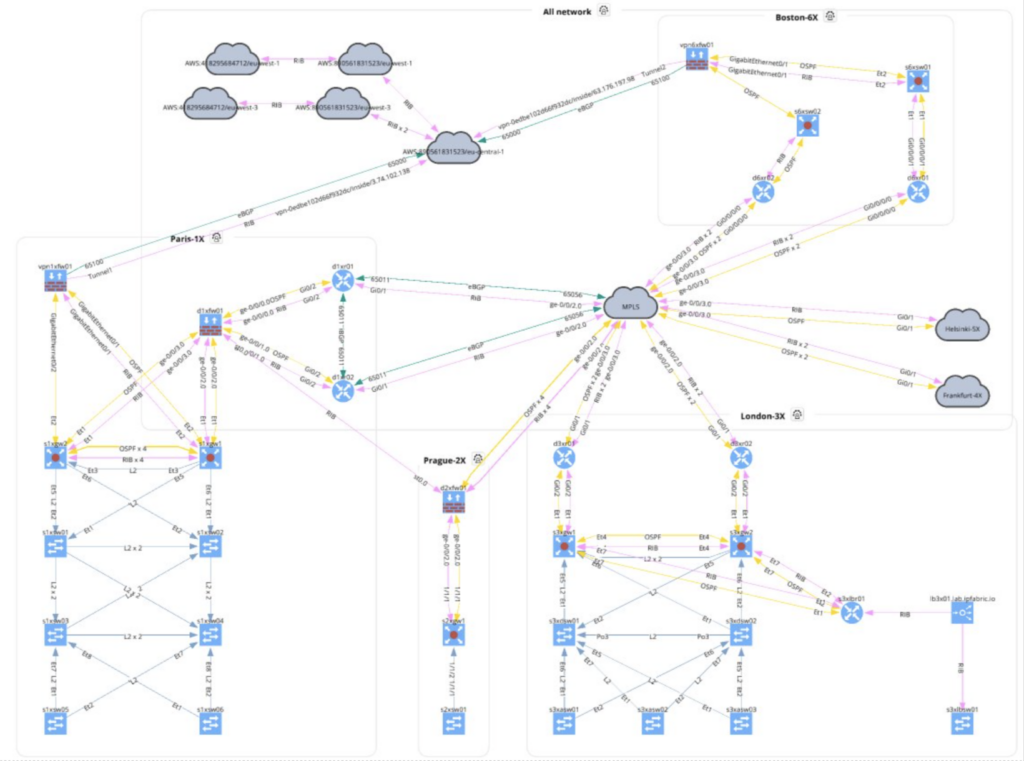
Learn more about how IP Fabric’s discovery works.
What Can You Do With a Network Model?
When you have a reliable, always-updated network model on hand, it acts as a ground truth for any operational, security, or compliance workflows. To give you a few ideas, we’ve seen customers use this model for:
- Discovering shadow devices, unexpected paths, and relationships that don’t show up in any IPAM or CMDB.
- Validating that configurations, BGP routing, firewall rules, and more are all actually behaving according to business intent.
- Referencing historical snapshots of the network during security and regulatory audits, or during troubleshooting and incident resolution.
This historical dimension also has an upside for AI. If an agent can understand how the network has evolved over time, it can reason about the effect a change may have before it makes it, weighing what it’s about to do against how the network has actually behaved through similar changes in the past.
How Do Network Digital Twins Help with Automation and Agentic AI?
Every organization is on their own unique automation journey. IP Fabric is useful at each stage of that journey, including:
- Augmentation: IP Fabric can remove friction from day-to-day workflows by automatically gathering and normalizing data across disparate tools.
- Automation: Once a ground truth is established, you can build automation against it. Network models can be used for checking network behavior against intent, validating changes, troubleshooting incidents, and assembling data for audits.
- Agentic operations: AI agents can reason over network changes, diagnose issues, validate deployments, and more. But to do that they need a reliable model of network behavior, and a clear picture of design intent. IP Fabric provides the behavioral model, and integrates with intent platforms like NetBox and ServiceNow to give agents all the layers together.
The common thread across all three stages is trust. Your trust in the data should build as you work through each stage, and that trust is what will give you the confidence to progress to the next.
Learn how Red Hat is using IP Fabric to fuel reliable network automation and AIOps.
How Do You Build Safe Network Automation?
If you want to see progress towards agentic—and eventually, autonomous—operations, you need to start with a documented understanding of your network’s actual behavior. You need to take the years’ worth of institutional knowledge that’s locked in your engineers’ heads, and make it available as a complete, normalized, and continuously updated network model.
When every human, automation tool, and AI agent is working from this unified ground truth, you can build up the trust you need to embrace automation and agentic AI safely, without putting your network at risk. At its core, this is the purpose of a network digital twin: to close the gap between the network you intended, and the network you actually have.
FAQs
What Happens When You Don’t Have the Right Data For Network Automation & AI?
Automation amplifies whatever you feed it, so incomplete or stale data will spread errors across your network at machine speed. Maybe a device was missing from your CMDB, or a configuration change slipped past your records. At enterprise scale, those gaps add up. If an AI agent acts on data with gaps like that, it can push changes that lead to outages or noncompliance with security and regulatory standards.
What Kind of Data Do You Need For Network Automation & AI?
Individual data points only get you so far. What really matters is how your devices interact, as those interactions determine how traffic moves across your network. A good network model captures those connections, so you see the network as one working system rather than a stack of separate devices. An AI agent needs that same whole-network view to make sound decisions. A network digital twin gives you that view, along with the confidence to adopt automation and agentic AI without putting your network operations, security, or compliance at risk.
How is a Network Digital Twin Different Than a Monitoring or Observability Tool?
A monitoring or observability tool tracks live activity and tells you what happens moment to moment, from traffic spikes to interface errors to device health. A network digital twin models the structure and behavior of your whole network, so you can validate how it runs, compare its state across different points in time, and reason about how it will respond to a change. IP Fabric works upstream of your monitoring and observability tools, where it discovers and maps your network’s real behavior and then pushes that verified picture into the tools your teams already rely on. As a result, every team and tool downstream draws from the same accurate, current view, which allows them to make more informed decisions about the network.
How Is a Network Digital Twin Different Than a Source of Truth / IPAM / CMDB?
A source of truth, IPAM, or CMDB records the network you set out to build and holds your intended inventory, addressing, and design. A network digital twin shows you the network you actually run and confirms whether it behaves the way you expect. These tools complement each other, and leading enterprises like MLB and Red Hat point to IP Fabric at their ground truth for validating network behavior against intent as they automate.
Want to see IP Fabric in action? Try our self-guided demo today.