
 Blog
Blog Let’s say you manage the network for a manufacturing company with sites around the globe. You’ve got thousands of devices, hundreds of vendors, and dozens of different technologies to manage, including platforms like:
- Amazon Web Services (AWS)
- Azure
- Google Cloud Platform (GCP)
- Cisco Meraki
As your cloud footprint grows, it becomes harder to keep all these platforms up to date, leading to a “source of truth” that isn’t as reliable as you’d hoped. This fragmented visibility not only impacts day-to-day network operations—like change management and compliance validation—but also throws a wrench in large-scale IT projects like mergers and acquisitions (M&As), SD-WAN rollouts, cloud migrations, and more.
In this blog post, we’ll dive a little deeper into all the reasons why hybrid multi-cloud visibility is so important. From there, we’ll cover a few ways you can use a network digital twin to achieve end-to-end visibility and control.
Why Does Network Visibility Matter?
As the saying goes, you can’t control what you can’t see. Whether you’re making a small change or kicking off a huge migration project, you need to be able to predict how your network behavior will react. If you’re not in control, the consequences can ripple across your organization—putting operations, compliance, and your budget at risk.
How Does Network Visibility Impact Operations?
If you’re like most organizations, you’re probably implementing network automation, or planning a major migration (or two). But unless you’re 100% confident in your network visibility, any change can be a double-edged sword.
Let’s consider a network automation project as an example. On one hand, if your automation isn’t informed by the most accurate and up-to-date information, it can result in a ripple effect of errors that delays critical workflows. On the other, if you choose not to implement automation because of these risks, it’s impossible to keep up with the pace of change that’s required to govern enterprise environments.
How Does Network Visibility Impact Compliance?
When it comes to compliance audits, ignorance most certainly is not bliss. No one wants an auditor to uncover a risk they didn’t know about themselves. But if we look past the looming threat of noncompliance fines and reputational damage, you’ll see that a lack of network visibility can impact your day-to-day workflows as well.
For most enterprise-scale organizations, it can take a month or more to gather evidence for security and regulatory audits. Your senior engineers are stuck documenting the network, only for it to be out of date by the time they’re done. This cycle repeats once, or sometimes twice a year, slowing your progress towards more meaningful and revenue-generating NetOps initiatives.
How Does Network Visibility Impact Cost?
Every error has a price tag, and this is especially true when it comes to your CMDB. As much as 20-40% of CMDB data is incorrect or outdated, leading to needless spend on:
- Operational expenses (OpEx), like maintenance and renewal fees.
- Capital expenditures (CapEx), like underutilized devices and more expensive gear.
- Downtime, which ranges from $39,000 to $2 million per hour in industries like manufacturing.
- Security and regulatory penalties, which can easily reach into the millions.
In other words, network visibility is the key to pinpointing and avoiding unnecessary costs at virtually every level of your business.
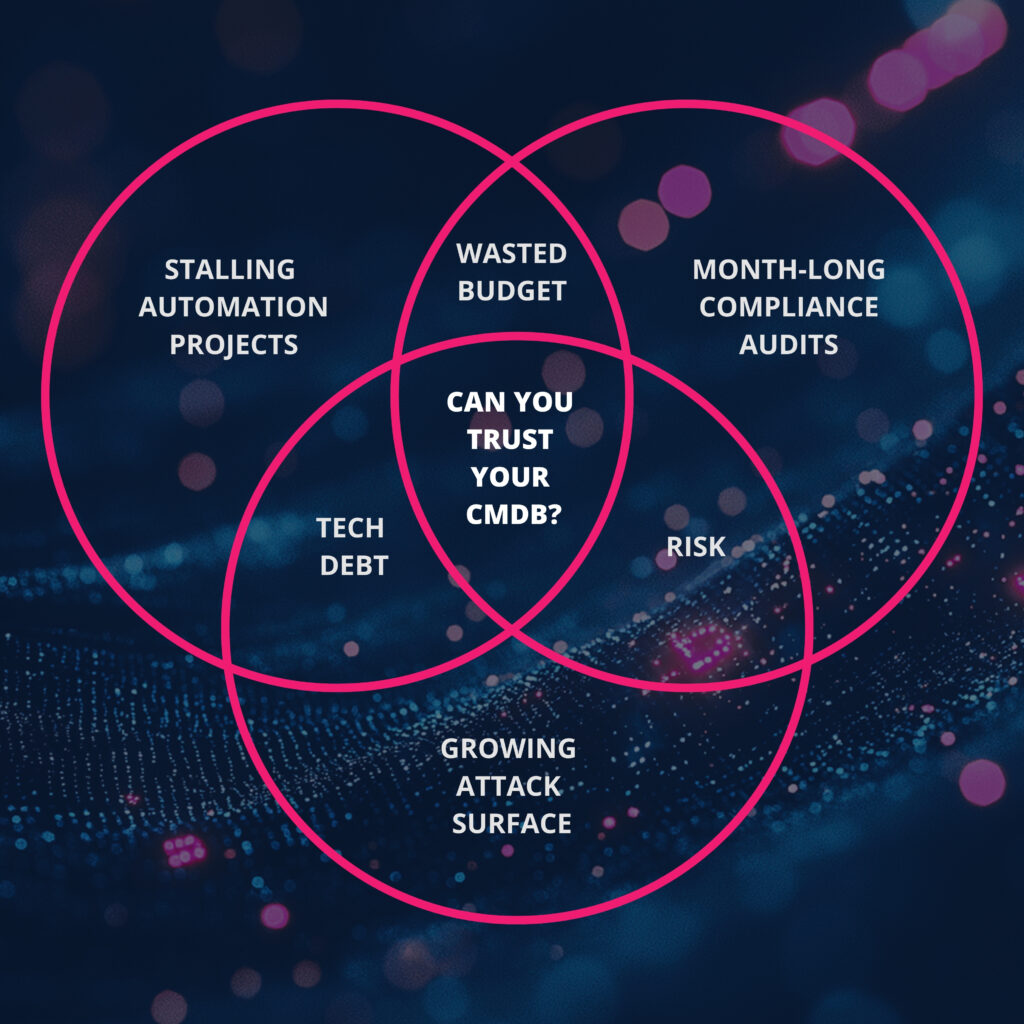
Learn more about IP Fabric’s support for ServiceNow CMDB.
What Is a Network Digital Twin, and How Does It Improve Network Visibility?
So, how do you get a reliable view of network paths across on-prem and multi-cloud environments?
The short answer: A network digital twin. IP Fabric’s category-leading platform can pull an end-to-end snapshot, or digital copy, of the network in a matter of minutes. This speedy discovery gives customers the flexibility to run several snapshots per day, ensuring that they always have complete and accurate view of their network’s state and behavior.
What Does a Network Digital Twin Look Like?
IP Fabric discovers the network from core to cloud to edge using a combination of automated CLI and API calls. The resulting snapshot shows the following data in a vendor-neutral format:
- All service logs and commands issued to every network device.
- All connections and configurations, comprising the network’s overall state.
- All results of IP Fabric’s automated intent checks, which can be used to monitor regulatory compliance policies, security policies, automated workflows, and custom business requirements.
Together, these components give customers a complete picture of how their network is behaving at a given moment in time. It either proves that your network is acting as you inteded, or helps you to pinpoint exactly where it’s not.
What Cloud Platforms Does IP Fabric Support?
IP Fabric supports all major cloud vendors, including Cisco Meraki, GCP Interconnect, Azure Firewall, Private Link, Private Service Connect, and VNet, as well as unified public IPs. No matter the platform, IP Fabric incorporates the following data into every snapshot:
- Firewalls
- Private link services
- Public IPs
- Cloud subnets
- Private endpoints
- Endpoint groups
- Vendor-specific tables
All network snapshots are normalized, so that you have a source of truth that anyone in your IT organization can access and understand.
IP Fabric also makes it easy to import or export data, like device attribute data for CMDB syncs, or proof of compliance for security and regulatory audits. This level of visibility can remove the roadblocks that many organizations face, especially when it comes to ambitious digital transformation projects.
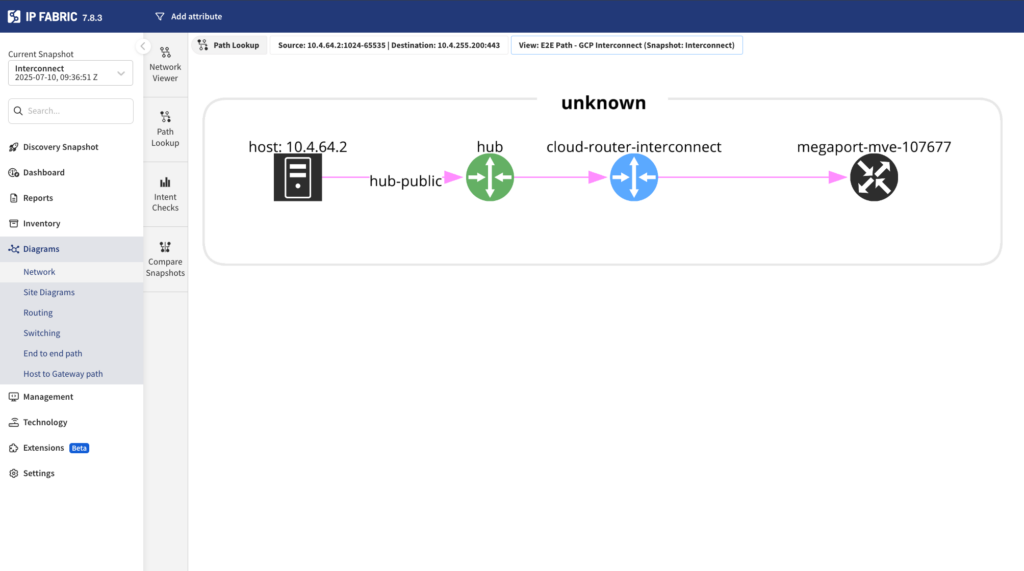
IP Fabric offers accurate path and dependency mapping for seamless hybrid connectivity in GCP Interconnect.
What are End-to-End Path Lookups?
IP Fabric’s end-to-end path lookup feature traces the complete route a packet takes from source to destination across your hybrid multi-cloud infrastructure. This can be used to simulate the effect a change might have on your network before you actually make it, so you can avoid any unwanted surprises down the line. The result? You can effectively de-risk day-to-day change management as well as large-scale IT projects like M&As, SD-WAN rollouts, network automation, and more.
After changes are pushed to production, IP Fabric runs a series of custom and built-in intent checks across millions of infrastructure data points to ensure that your network is behaving as intended. If your network deviates in any way, IP Fabric surfaces violations in an actionable and highly contextualized report.
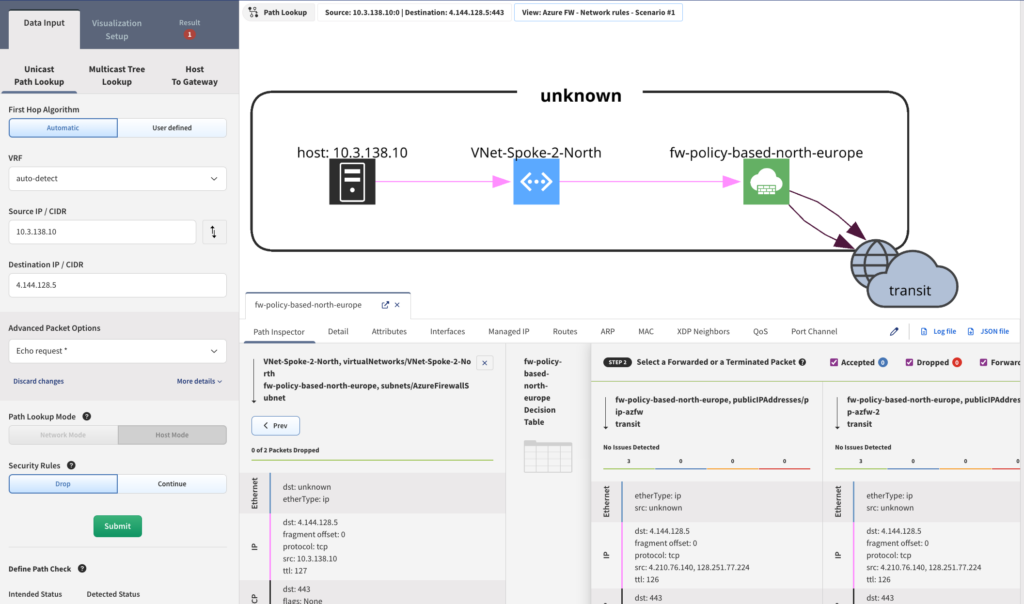
IP Fabric delivers visibility into network security for platforms like Azure Firewall.
Multi Cloud Visibility Is a Must
Network visibility drives every decision you make, from routine changes to enterprise-wide transformations.
In this blog post, we talked about three ways to improve network visibility with a network digital twin:
- Run multiple snapshots per day to maintain an accurate, real-time source of truth across your entire infrastructure.
- Use end-to-end path simulations to test changes before you push them to production, so you can avoid costly errors.
- Automate intent verification across millions of data points to catch deviations and remediate them before they have the chance to interrupt critical operations.
When you can see your entire network in a single, normalized view, you can finally shirk off the guesswork and free your team to focus on the strategic initiatives that move your business forward.
Have questions? Try our self-guided demo or book a meeting with one of our experts today!
FAQs
What Are the Most Common Challenges That Enterprises Face with Hybrid Multi Cloud Visibility?
When teams rely on siloed tools and platform-specific views, multi-cloud visibility breaks down. Each cloud provider exposes data differently, and traditional network tools struggle to correlate that information with on-prem infrastructure.
As environments grow, documentation falls out of date and engineers lose confidence in their data. These gaps slow down change management, complicate compliance reporting, and increase operational risk. A network digital twin like IP Fabric can solve these problems by offering a unified, normalized view of how everything connects and behaves across platforms.
How Is a Network Digital Twin Different From Traditional Network Monitoring Tools?
Traditional monitoring tools focus on vendor-specific metrics and alerts, while digital twin platforms like IP Fabric provide a normalized, centralized, and contextualized view of the network. IP Fabric’s digital twin platform also measures your intended network against your actual network, so you can quickly pinpoint any places where the two diverge.
Network digital twins also offer abilities that traditional monitoring tools do not, like the ability to simulate network behavior before deploying changes. This shift moves network teams from reactive troubleshooting to proactive decision-making and network assurance.
How Do Network Digital Twins Help with Change Management?
IT and network teams can reduce the risk of change management by running end-to-end path lookups in IP Fabric. These path lookups show how traffic flows across devices, firewalls, cloud services, and interconnects. This visibility allows teams to test proposed changes against the digital twin before pushing them to production.
After deployment, IP Fabric’s automated intent checks confirm whether the network is behaving as expected. If something breaks, engineers can quickly pinpoint the exact configuration or dependency causing the issue. This workflow empowers teams to move faster, without sacrificing stability or control.