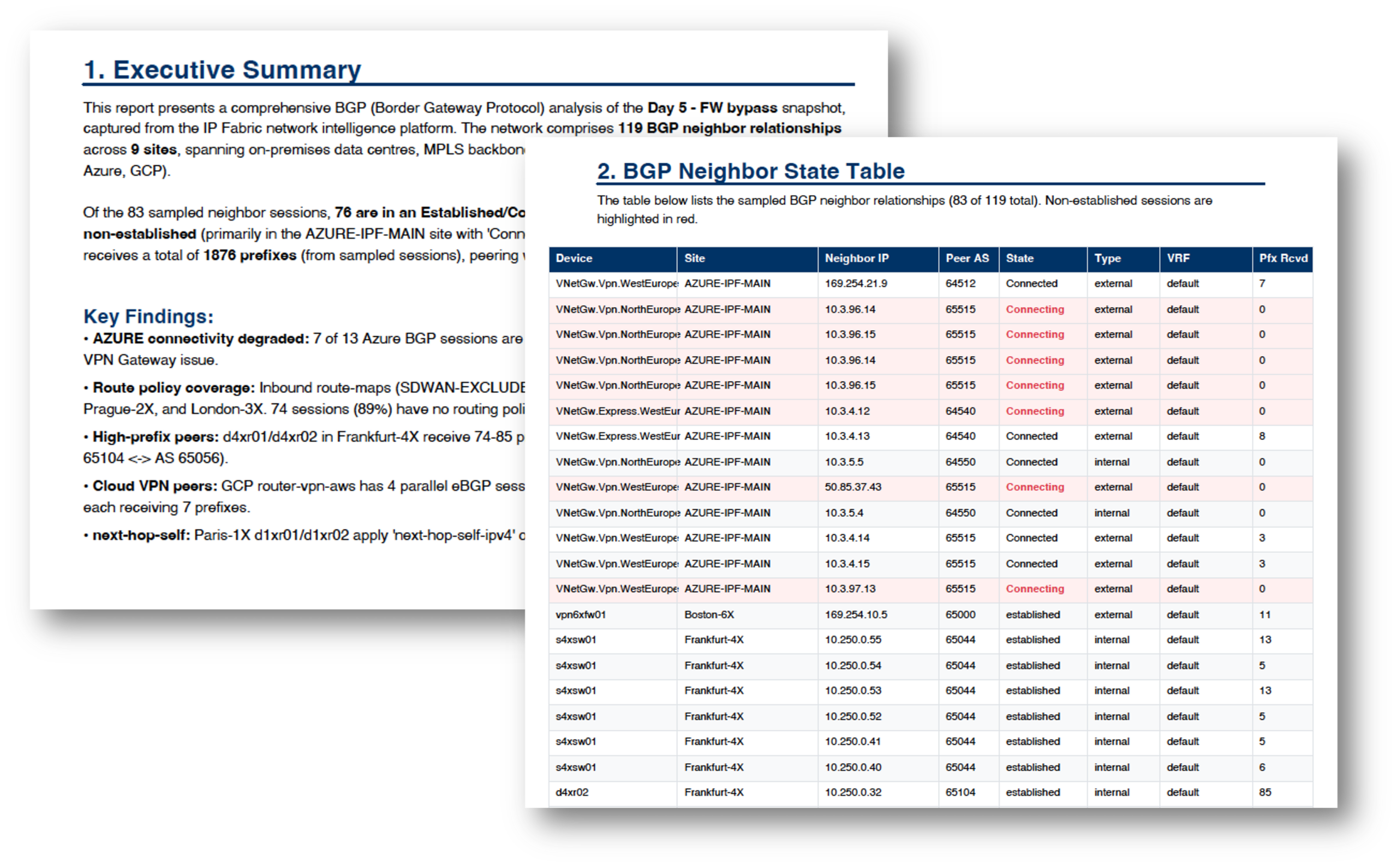
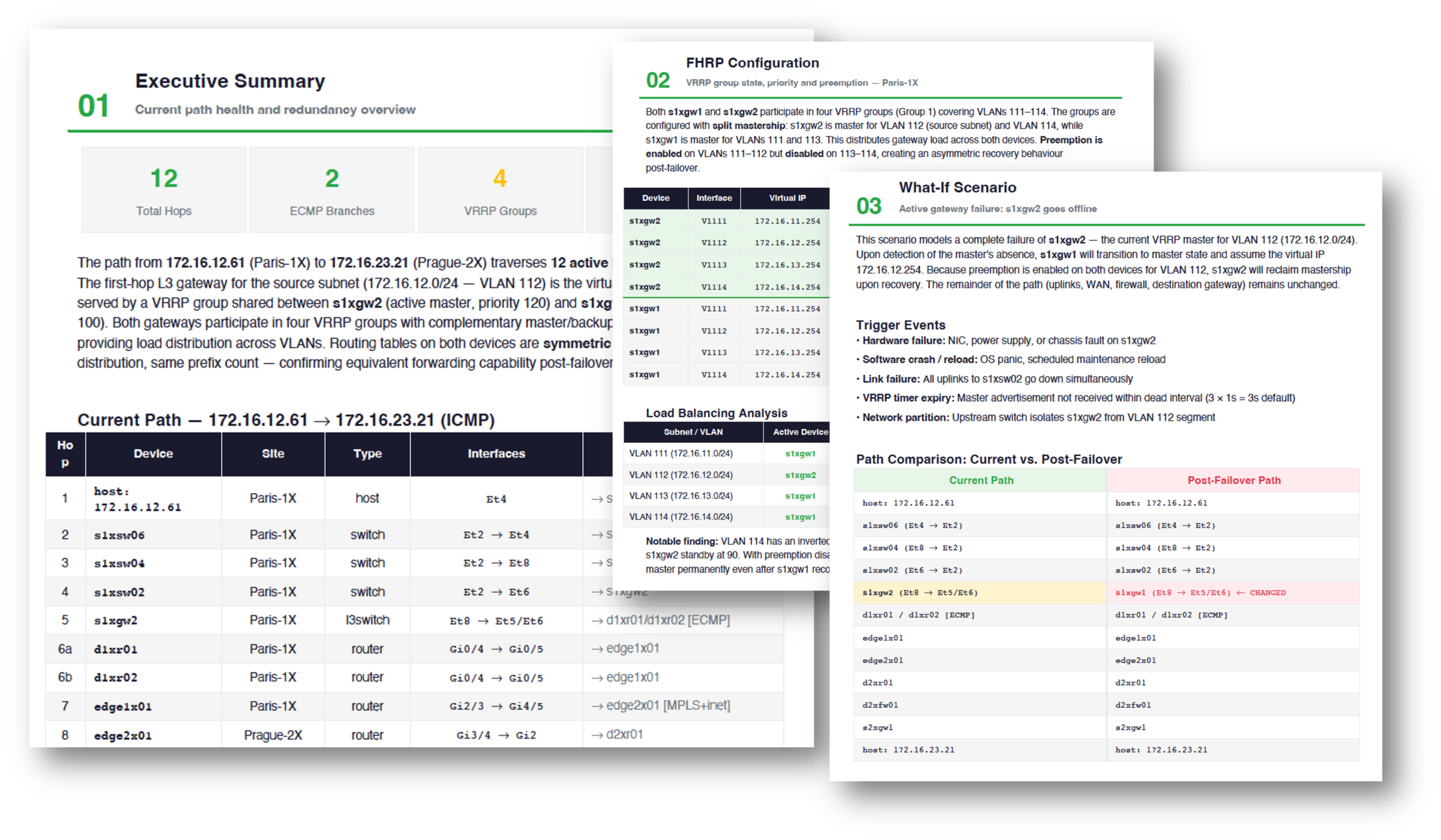
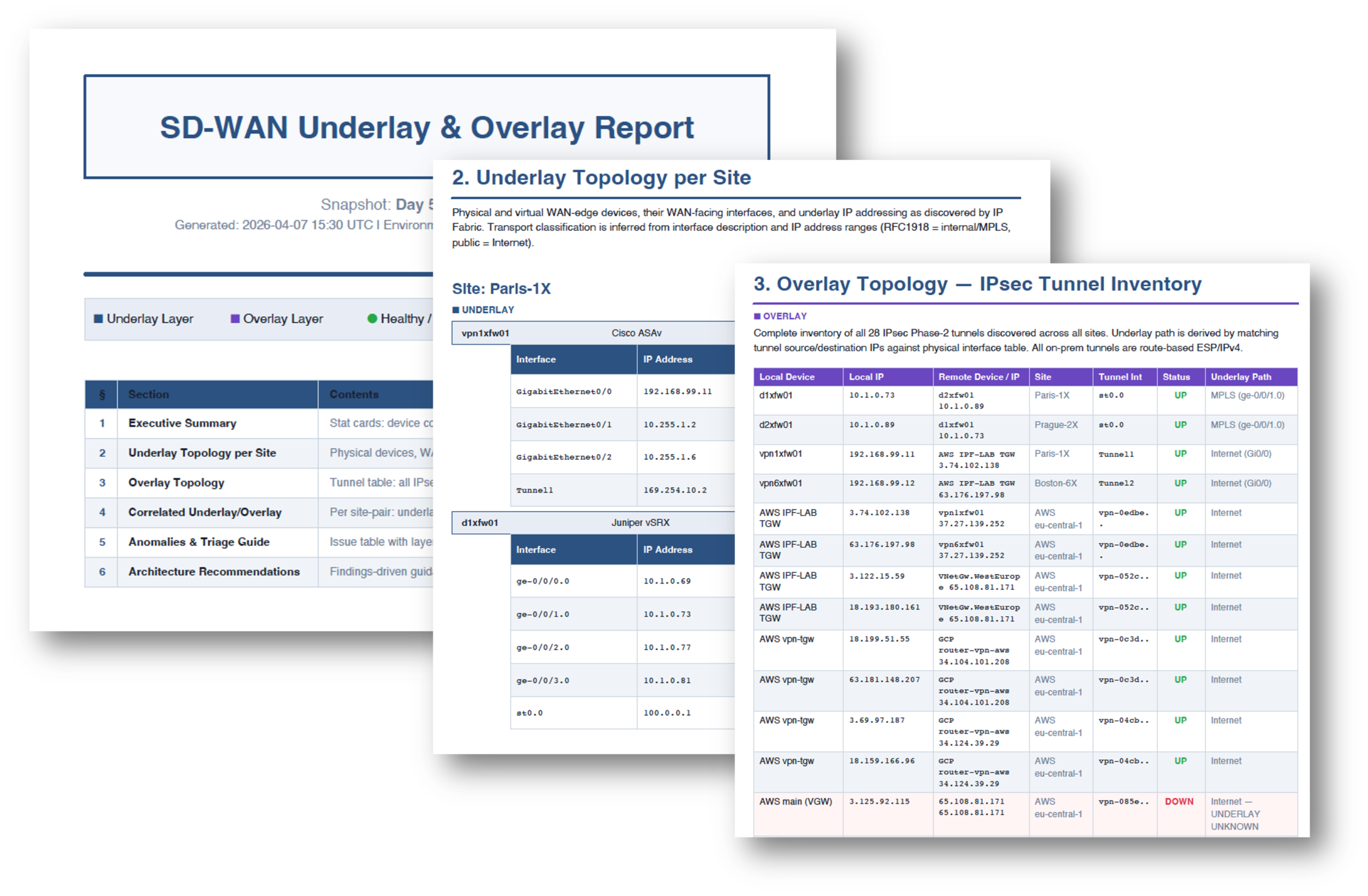
Our enterprise-grade MCP server exposes IP Fabric’s validated network intelligence to the LLMs you're already using, from Claude to Copilot and beyond. From there, your team can send natural language queries to your network with no code or custom integrations required.
This personalized demo will cover how to use the MCP server for:
You'll also walk away with our expert-tested prompt library, as well as an overview of how IP Fabric handles MCP security.
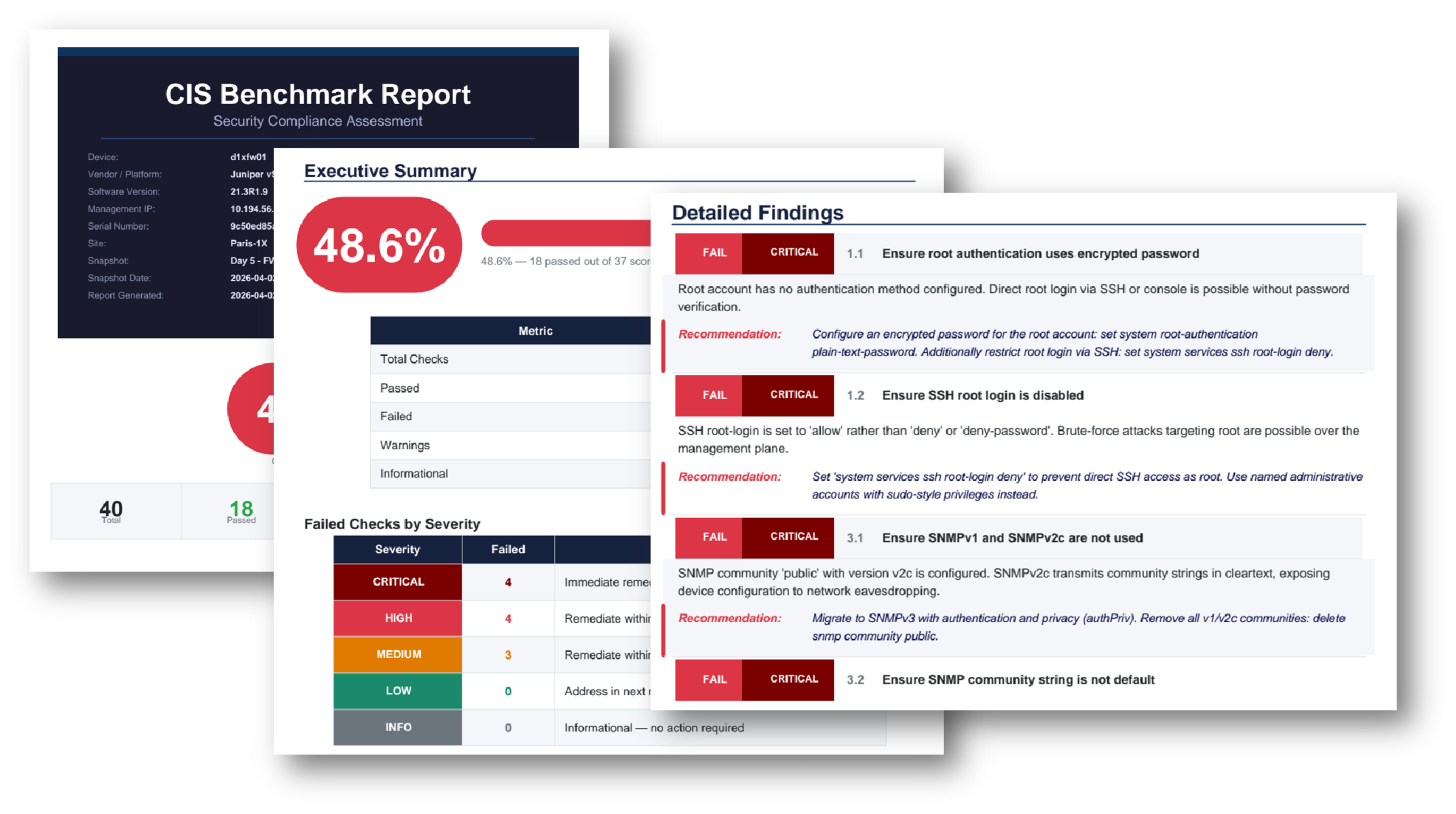
Analyze your holistic compliance posture from core to cloud to edge, surfacing any gaps for quick remediation.


Run multiple checks in parallel, automatically correlating the results against IP Fabric's topology model, and surfacing the most likely root cause.
Pull anomalies in BGP routing tables.
Identify OSPF MTU mismatches among neighbors.
Predict the most likely effect of a change before it reaches production. For example, if you ask the MCP server to simulate the impact of a first-hop gateway failure, you'll receive a structured report with:


Pull from IP Fabric’s separate underlay and overlay tables simultaneously to:
IP Fabric's MCP server is an abstraction layer that helps both humans and AI to retrieve accurate, normalized data using natural language. When you query the MCP server, you're really querying IP Fabric's latest snapshot of your network. These snapshots cover every device, connection, and configuration in your environment from core to cloud to edge. Equipped with this accurate, contextualized view of your environment, our MCP server ensures that your AI agents and human teammates have the data they need to make decisions about your network.
Sure, you can build a homegrown MCP server—but if you build that on top of incomplete or unstructured data, then your outputs will likely result in hallucinations and other errors. At the enteprise scale, you don't want your AI agents or human team members to be making decisions based off of this error-prone data, as those decisions can cascade into costly security, compliance, and operational risk.
In order to minimize outages, security risks, and compliance gaps, your AI agents need to be informed by reliable network data. That data must meet four core requirements, namely that it's...
Accurate and free of errors.
Contextualized by a complete understanding of network behavior.
Structured and normalized so that an AI agent can understand it.
Easily accessible, so an AI agent can get the data it needs, when it needs it.
If your network data is missing any one of these elements, then your AI agent may not have the data it needs to make trustworthy decisions.