


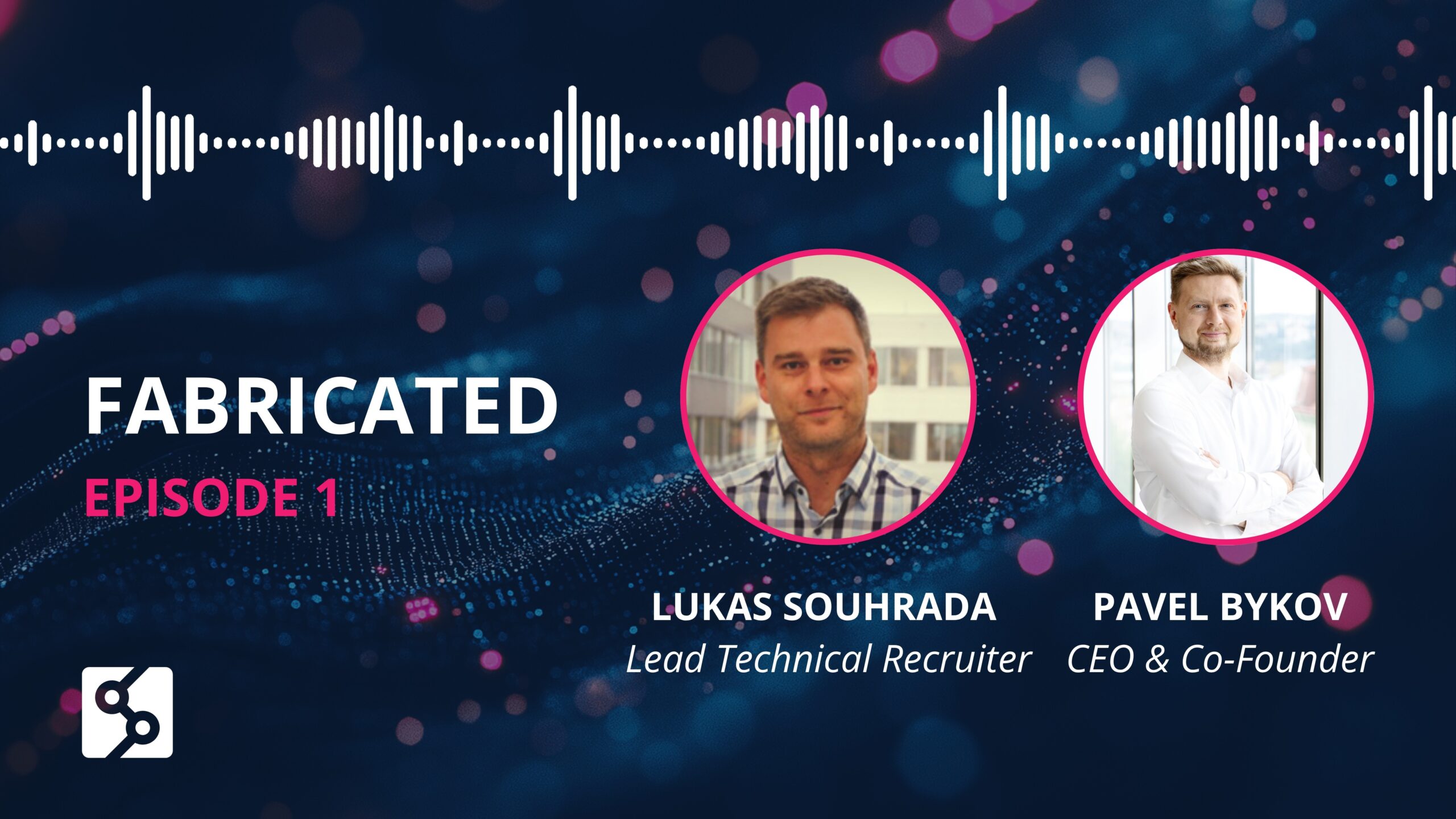
Join host Lukas Souhrada and guest Pavel Bykov as they weave together the stories, minds, and innovations behind IP Fabric. Explore open roles today!
Lukas Souhrada: Welcome to Fabricated, the podcast where we weave together the stories, minds, and innovations behind IP Fabric. I’m Lukas Souhrada from our people and culture team, and I couldn’t be more excited to kick things off with a very special guest today, Pavel Bykov, our CEO and Co-Founder.
Today, we’ll be diving into the story behind IP Fabric, where it all started, what drives our innovation, vision, and what it really means to build a company from the ground up in the world of network automation. I bet you are very curious to learn more, so let’s jump right in.
Pavel, tell me, let’s rewind a little bit. Can you take us back to the beginning of IP Fabric. What sparked your idea, and how’d you turn it into reality?
Pavel Bykov: Absolutely, and thanks for organizing this. It’s great that we can talk about these topics that people are curious about. But to talk about them in this fashion, it’s always a good time to reminisce about what we have achieved.
Going back to the origins, the idea was always there. I remember from the very first projects that I was on. I was lucky enough that my very first project was to build, back then, the largest IP call center in Europe at the time.
So starting with such a large project, you end up with the challenges of scale. There are these engineering questions like: How do you connect it redundantly, and how do you test the redundancies that are there today or the next day? And then deploying these very expensive monitoring systems that have not been able to even tell me what I’ve done with the network infrastructure because they just couldn’t see everything and were missing things. It had me thinking, well, there must be a better way.
And then, of course, finding out that a lot of engineers think alike. And that there were many efforts to solve this problem. But, as they say, the problem worthy of attack shows itself by fighting back.
And, so, I would say the idea was forming over the decade and a half that I was actively architecting and building large scale and global networks network infrastructures. Until the day when I found that it’s no longer possible to be in control of this global infrastructure without this technology.
Lukas S.: Tell me, what were the early days of building IP Fabric like? Do you have any funny moments or garage startup moments, or lessons learned that you’d like to share with us?
Pavel B.: Why do people end up in garage? Then you find out, well, it’s a place that allows you to build things, to experiment quickly, and to be there 24/7 without disturbing somebody. It does have its charm.
As for lessons learned, the entire journey is this big lesson learned. Starting out as an engineer that knows exactly how to approach and solve the problem, because the engineering mindset is to find the solutions. But, while solving a technical problem, you also have to understand all the other aspects of what’s needed to build a scalable company. So you start learning about sales and marketing and people organization. Those are very hard lessons, expanding your horizon, understanding what it takes to build a company.
Some people ask me: What would you do differently? And I would say: Pretty much everything. The point is that you cannot go back and regret what you’ve done. That’s a fallacy. We should be “Should’ve, could’ve, would’ve.” That's just unproductive.
But it is important to take in those lessons learned. To learn from not just your mistakes, but also from success. It’s actually much harder to learn from success than it is from failure because if it’s a fail, it’s definitive. But with success, there’s no absolute right or wrong. Somebody may be right to a point more than they are wrong. Especially when you don’t know about something and somebody comes in and says “I’ve seen that work somewhere else.” Well, it worked because that’s that place. That’s another company.
What defines you as a company. You have to build your own thing and take those experiences. That’s a good input. Combine it together. It’s what we are first and foremost, and then enhance it or augment it with those additional experiences to improve it further. But some things are just not really for us. So it’s really this entire journey of learning.
Lukas S.: That’s pretty much like the client’s infrastructure. You can have all sorts of devices, but every client has it differently done. So you can really apply a type of synchronous simple template.
Pavel B.: Exactly. That’s very similar to what we do. These complex supercritical networks are all built a little bit differently. You cannot have a network that’s always the same because there are specific companies, like service providers, especially of the residential services that have these cookie cutter services. You can buy small, medium, large T shirt sizes, and they they build that from the foundation. Like, that’s the only service that we provide. That’s our company. That’s how we work. However, the infrastructure, like the communication infrastructure of the companies, it has to closely mirror what the business does.
So then if that business does a certain thing, the networks have to enable exactly this certain thing. So that’s why the networking is different: because the companies are different. So there is a lot of similarities in that way. That’s what brings the fun into the business, actually, because if it will be simple, everybody else would be doing it. But this is why we can, you know, become the things in the market. What we are doing is definitely challenging. It is a very hard problem to solve. There is still a lot ahead of us.
Lukas S.: There’s gonna be a lot of fun still. Right? When you look at how far you have come, what is there something you are really proud of, or what are you the most proud of?
Pavel B.: I think that what we are tackling is a really fundamentally hard problem. As I said, the problem worthy of attack shows itself by fighting back. The impact that we had on the market and the way we are actually changing the direction… this overall mission that we are on is to democratize network infrastructure control for enterprises. We are having an impact. We are seeing companies use assurance language more and more. We are seeing that we’re able to prevent disasters, that we can secure our clients. The fundamental question that people have is: Am I doing something worthwhile? For us, we’re able to proudly answer that we’re having an impact and changing the world.
Lukas S.: That’s definitely something to be proud of. Reducing downtime, making sure airplanes can fly, cargo ships can sail. That’s definitely good. Pavel, what were the moments you were thinking: “This is too hard, this is not going to work”? And what did you do to overcome this?
Pavel B.: Yeah, I mean, there’s so many of them. It’s definitely a challenge. I think that when there are young companies, people need to essentially quit their job and completely dedicate to something fully because there are always obstacles. And some obstacles are just maybe too hard even. The resilience is definitely a big name of the game, building that character to be able to handle those moments.
I remember a revelation for me was a Waze founder, you know, the navigation line. He was showing the very first path that the car took around the square in in Bratislava, around the their roundabout. So that was the first line going one way, and then the car turned around, and because those are, crowd sourced maps essentially. And then he said that during his building, that he slept like a baby, meaning that he woke up every hour and cried. That just shows that you have to overcome the obstacles no matter what.
That form of resilience, whether it is learned or however you find it, everybody has their own way. But it is important to have that. You’re not alone. This is not a one man show. It is a company relying on people, relying on your co-founders, relying on your team, to make progress.
And sometimes if someone is down, somebody else is up, somebody else is down, somebody else is up, it’s challenging. It’s definitely not something that everybody can do, and that’s why so many companies fail.
I would also say that it’s important to balance things out. Like, you cannot have all fires. You know, if you have a fire and you have some firefighter running rushing to the fire, that’s good. But if everything is on fire, including your fire station, it’s out of sight. You cannot end up in that situation. I mean, it always has to be manageable. That’s why you need to have parts of your life.
I would say that my family was also a big part in supporting me throughout this journey. You cannot say that you did something alone because of your own. You’re there to change things, to have your impact, but just thinking that it's just you… You have to recognize that I have these people, I have these coworkers, and I want to be with them. I have the family who are supporting me. We’re all on this.
Like, you are there to, of course, to change things, to have your impact, but just thinking that it’s just you, you you you have to recognize that, okay, I have I have these people, you know, I have the, the coworkers that, I want to be with them. I have the family who are supporting me. And the environment. Creating this space that you can progress further, and not be alone. It’s definitely that success is built together.
We can set in stone because you cannot be firefighting when your own house is being flooded or something. Right? You have to have things set straight, so we can focus on things that matter.
Lukas S.: Pavel, tell me, is there a story of a milestone that you think perfectly captures what IP Fabric actually stands for?
Pavel B.: I think it’s, when a prospect comes up to us and says that “I’ve tried so many different products, but I’ve heard that yours actually works.” The ones running to the customer’s problem and solving this deep understanding of what the actual customer’s problem is and making it our business to solve that problem.
It’s really fundamentally who we are, that we are solving the problem of the hybrid cloud infrastructure controlled in enterprise space, and we’re in reputation for it by being the company that actually can tackle this super hard problem.
Lukas S.: Pavel, IP Fabric is now hundreds 30 people strong. Tell us how do you stay connected? How do you remember all those names and stories still?
Pavel B.: I mean, the secret is simple. Like, you have to genuinely care. The culture is extremely important. And genuinely creating what we care about makes a difference. You know, I’m even here with you because you are doing a good job of talking about our company. What was really inspiring for me that you care about that work. Knowing all of these stories is not for me something that I have to keep remembering, but my caring about how we build the company overall and just genuinely being invested. This is what we’re building, which makes that super simple.
And, you know, each and every one of us is a little bit different. So this is maybe the hint of remembering everybody’s story because each and every one is kind of unique within the company. This is what builds IP Fabric, I believe, because if we all would be the same, we would be basically tackling the problems and virtual interest in the same way that won’t bring the results.
Another revelation I had recently, like, you as you said, you know, be around 130 people. Like, imagine taking just 130 people, let’s say of the similar skill set and just saying them, now you’re doing this company. Is this going to be IP Fabric or not? No. I don’t think so.
Like, what makes us us is that we have those internal properties. Someone said we are the company with a heart, that we are genuinely invested in fundamentally addressing this important infrastructure issue. That, admittedly, infrastructure is not exactly the most exciting of spaces, but it is fundamental for this digital world. And somehow, bringing our unique perspective, but fundamentally remaining part of IP Fabric, is really makes a difference.
Lukas S.: I totally agree. It’s fun to see the developers, network support engineers, and financial people actually working together, going on a team building and having fun because it’s so many different personalities. Some of them are open, some are more introverted. Suddenly you see them working together, playing activities, and that’s great. How about tell me what’s one thing that still surprises you about leading a fast-growing company?
Pavel B.: I think it’s how much we’re changing the field. Once you push and you are creating this change… how many really motivated people there are that want to have an impact on the industry and how much we are able to to drive that change. That is really surprising.
Lukas S.: That’s cool. Pavel, if you could teach every new joiner in the company some little Pavelism about IP fabric, what would it be?
Pavel B.: I think it is, running to a challenge that we are really solving the problem for the customer and genuinely care about the problem. That has to be part of the work.
Lukas S.: Pavel, what are the biggest challenges that IP Fabric is facing right now and what excites you the most about this?
Pavel B.: I would say the execution maturity curve. It’s getting steeper and steeper. There are not as many external factors that are limiting our potential. It’s really the problem that we’re solving is really hard, and how well we are able to solve that problem that we are the so-called masters of our own fate and this is also what's exciting at the same time.
Lukas S.: What are the current trends in network automation? What are you watching closely right now, Pavel?
Pavel B.: Well, compliance is getting pulled into networking more and more. I would say from the point of view of what is expected of this foundational technology, larger companies, the expectations are just higher and higher, now that there were introduced even criminal penalties for noncompliance.
Everybody understands that it’s much more critical technology than it was in the past. I would say the biggest trend is the network assurance that we have started and that we have pushed throughout the industry.
That, of course, I think is the most exciting, because of all of the impact that that we are having. I mean, of course, there are others, like consolidation. There is SASE, even consolidation of the software-defined networking products. There’s this kernel level eBPF. But there are really always exciting things happening if you look under the hood. But for me, it’s to stay our course and develop the network assurance trend further.
Lukas S.: As we grow, how do we stay true to our mission?
Pavel B.: I would say by living it, every day. We are not building a new company every day, but we are solving a specific problem in the market, and we have to stay true to this mission and truly live it every day to develop it further.
Lukas S.: What is the one strategic move that you’ve done recently that’s going to help shape our next chapter at IP Fabric?
Pavel B.: I would say by investing more in our talent, building the management team. So investing in what talent we have in the company. People have the biggest impact on what your company is.
Lukas S.: And the company is only as good as the people you have. By the way, you’re based in Boston currently and you fly quite frequently to Prague. Tell me, how do you stay in shape and what’s your secret to surviving all that travel?
Pavel B.: It is demanding. There is a saying: “Know thyself.” It is about knowing your body’s limits, knowing your body’s cadence, what you are able to achieve on a consistent basis because I’m sure that we all are capable of great things in the short run. But, doing something on a very consistent basis, everybody needs to find their own pace. And the balance that allows us to sustain such a prolonged, heavy load.
Lukas S.: And do you miss your family when you’re in Prague and I’m not staying in Boston?
Pavel B.: I’m making sure that I don’t miss them for too long of a time. So definitely that is a big factor that I cannot be spending away from my family for too-long periods consistently.
Lukas S.: What’s your sort of internal limit? Is it, like, a week or a month?
Pavel B.: I would say a week. Definitely a week. And then if it is longer, then I would make my way back for at least for a weekend.
Lukas S.: And do you do miss Czech food when you’re when you’re in Boston?
Pavel B.: So my wife cooks very well. I don’t because she cooks the same food that she cooks here. She cooks there as well. And I do have a family to support me. My in-laws take care of me when I’m here. It’s more of that, I would say, just generally restaurant food. I have to limit restaurant food because of how at least my body reacts. I cannot eat in restaurant every single day for for a prolonged period of time. So I am looking for this home-cooked meal, and, you know, my wife can quick can cook mean svíčková even in Boston.
Lukas S.: That’s a miracle. So you’re not getting any gourmet shocks or cuisine shocks, traveling. But you can get culture shock?
Pavel B.: Well, culture shock because I also went and lived in The US around two years ago. So I’ve had my culture shocks back then. It is a different world to live in. There are many, many specific nuances that are mind-boggling for, for many people that are, outside of that culture. I would say there are these little things that make you just go, “Oh, that’s weird. It’s strange.” There are a bunch of small things that people know about as well, you know, traffic lights on the other side of the street. Turning right on red. These large rain gutters that are housing alligators, for example, in Florida quite a lot. And also, there are just a lot of these specific, small culture differences that, in the end, they do impact how people behave, as well. So definitely there is a significant culture shock.
You cannot be missing your food for too long because that also relates with how you deal with the overall physical demands of this international travel, like the jet lag and all of these things.
And, you mentioned it at the beginning. You know, you cannot apply one principle to all the people because we are all individuals. What’s working for one person is not going to work for another. On the jet lag, I’ve heard so many things, and it’s always different. I can say that’s good that you found it. Good for you. But this is what works for me.
Lukas S.: That’s definitely magic. When you’re not running a high growth company, Pavel, what do you do to unwind a little bit? And any hidden hobbies or secret talents?
Pavel B.: Well, that’s why they’re secret. Right? I wouldn’t say that they’re something special. I like spending time with my family and traveling. But right now, I’ve traveled quite a bit. I think, I’ll need to find some new ones.
Lukas S.: So besides being with the family, do you like hiking or cycling? Something like this?
Pavel B.: Yeah, I do. I definitely do that on a regular basis. I do have this cadence that the week is for working and the weekend I usually spend with the family. I try to spend most of my weekends with the family, hiking, cycling, and exploring, exploring areas nearby. Well, because compared to the Czech Republic, the US is definitely a different nature. Different views and such.
Lukas S.: What’s your go-to meal? What’s your kind of comfort food or your favorite guilty pleasure? Tell us.
Pavel B.: When I moved to the US, I loved burgers. I felt like the only thing that I eat here, from when I order in the restaurant, I eat burgers all the time. But I must say, like, eating burgers for over a year, I think I’ve had enough of that. So recently, I switched to to pizza.
Lukas S.: So for a year, you’ll survive in pizza, and then it will be off the list again.
Pavel B.: But I think it’s also important not to indulge in those guilty pleasures for too long because then I can tell. I had this taste for burgers and I should have maybe ate less burgers to still like them. Now I ate too many burgers and I don't mind a burger every once in a while anymore, but definitely indulging those guilty pleasures in the US with all those options they have there.
Lukas S.: That’s a good choice. So IP Fabric is pretty much ten years old as a company. Do you have an idea about the future outlook? Where we’re gonna actually go in next years? What’s the mission? What are the challenges and maybe adventures that lie ahead of us? Do you have an idea now?
Pavel B.: So the problem in the market remains unsolved that we are not yet in every single large enterprise. The companies are realizing that our technology is inevitable. We do see more competitors coming onto the market. And for us as a company, how we grow, it still remains the the main challenge to tackle and the most exciting part of working here: that we are building fundamentally impactful technology. Our work is important, and we are making a change in the world. It’s making an impact, so we’re gonna be proud of something in the future. It’s not about just maintaining the course. Every stage is completely different. We know how the company would look like if it became a behemoth. But how to get there? How to get to that full market coverage? What has to be true for us to expand to that level? And how do we scale? That remains a fundamentally important question to answer.
Lukas S.: And this brings us to the end of today’s conversation. Huge thanks to Pavel for sharing all his ideas and also the outlook for the future. If you like this, please follow-up, share, comment, and there will be definitely more to come. So definitely, you can be more curious about other podcasts coming in.
Pavel B.: And most importantly, get in touch with Lukas. We’re always on the lookout for great talent.
Want to build the future of network assurance? Explore open roles today.